
Why it matters
It turns steampunk's love of clockwork into full cosmology, making machinery not just technology but the structure of creation.
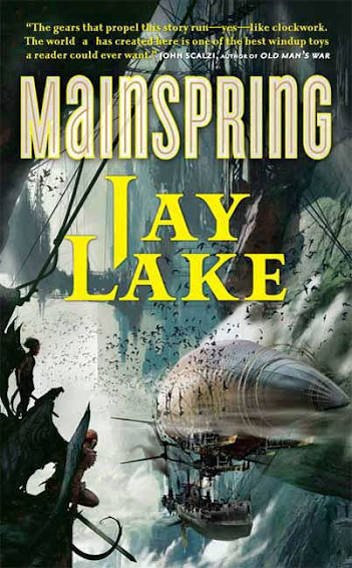
Jay Lake's Mainspring takes the old metaphor of a clockwork universe, peers at it thoughtfully, and then makes the gears large enough to become a theological and geographical inconvenience.
Mainspring is one of the stranger and more useful entries in the maker-era borderlands because it literalises an idea that has haunted science, theology and fantasy for centuries: the universe as mechanism. In Lake's world, the Earth and heavens are not merely described as clockwork. They are clockwork, with gears, tracks and a divine engineering problem at the heart of the story.
The novel follows Hethor Jacques, a young clockmaker's apprentice who receives a mission connected to the great mainspring of the world. That premise immediately moves the book beyond ordinary steampunk. The machine is not an airship, engine or automaton. It is reality's operating principle. The workshop has expanded until it includes the cosmos, which must be inconvenient for anyone trying to find a clean bench.
The field-guide label "clockwork cosmology" is ideal. This is not standard Victorian retrofuturism, though it shares steampunk's affection for gears, craftsmanship and visible mechanism. It is closer to metaphysical clockpunk, theological fantasy and planetary adventure. The point is not just that people build machines. Creation itself appears to have been built, wound and left in need of attention.
That religious machinery motif gives the book its distinctiveness. Steampunk often flirts with deism, natural philosophy and the old metaphor of God as watchmaker. Mainspring turns the metaphor into setting. This allows Lake to explore faith, duty and wonder through mechanical imagery without reducing the result to a simple gadget story.
The book also belongs to the Maker & Masquerade Age because it resonates with the broader cultural fascination of the period: gears as symbols, visible mechanisms, craft aesthetics and the romance of things made. Yet it uses those symbols at a grander scale. A decorative gear on a hat is one thing. A gear in the firmament is another, especially if someone expects you to fix it.
Hethor's apprenticeship is part of the charm because it grounds the cosmic idea in craft. The person called to respond to the machinery of creation is not a king or imperial engineer, but someone trained to understand smaller mechanisms. That scaling-up is very satisfying. The skills of the bench become, in fantasy form, relevant to the heavens. It is the steampunk maker fantasy elevated to theology.
The novel's religious machinery also complicates the usual relationship between invention and authority. If creation is engineered, then faith, duty and repair become tangled. Is the world a sacred object, a broken machine, a test, or all three? Lake does not need to answer in tidy terms for the premise to work. The question itself gives the book its peculiar charge.
As steampunk-adjacent fiction, Mainspring widens the field's vertical axis. Some works go backward into history, some sideways into alternate worlds, and some upward into cosmology. Lake's novel asks what happens when mechanical imagination becomes sacred architecture. That is a different route from The Difference Engine or Mortal Engines, but recognisably part of the same fascination with machinery as world-shaper.
Purists may argue it is not steampunk because the machinery is too cosmic and the genre markers are not primarily industrial. That is reasonable. The better answer is to call it clockwork cosmology, a borderland form with clear ties to clockpunk and steampunk's mechanical imagination.
Is it really steampunk?
It is steampunk-adjacent rather than core steampunk. Mainspring uses clockwork, craft, apprenticeships, mechanical metaphysics and alternate-world adventure, but its central concern is cosmology rather than industrial history. It sits beside steampunk as a clockwork cousin.
The novel is useful because it makes machinery symbolic without making it empty. The gears are not just decoration. They express an entire worldview. That matters for a field often accused of sticking cogs onto things for effect. Mainspring answers by making the cogs carry the universe, which is one way to silence the complaint.
Readers who enjoy Pasquale's Angel for its pre-steam mechanical imagination or Airborn for its alternate-world adventure may find Mainspring a natural, stranger step. Those who prefer strict Victorian politics may find it too metaphysical. Either way, it marks an important border where steampunk's visible machinery becomes myth.
It also helps the guide distinguish between machinery as aesthetic and machinery as worldview. Many books put gears on objects. Mainspring puts gears into ontology. That is a grander, riskier move, and it earns the book a place among the canon's curiosities rather than among its simple adventure engines.
The result may be too metaphysical for readers who want city smoke and political intrigue, but it is valuable precisely because it stretches the category. Steampunk's clockwork imagery can become lazy decoration. Lake asks what happens if the clockwork is literal, sacred and in urgent need of maintenance.
Find it
If you would like to track down Mainspring, these search links may help. We have not specified an edition, so you can pick the format that suits you.
Affiliate links: as an Amazon Associate, Stephen Hunt’s SFcrowsnest earns from qualifying purchases. These may earn us a small commission at no extra cost to you.