
Why it matters
It offers a lively modern example of alternate-history steampunk built from historical figures, folklore, time distortion and pulpy investigation.
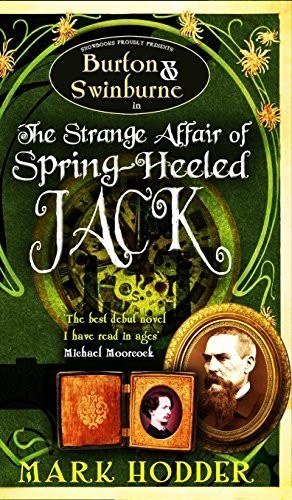
Mark Hodder's The Strange Affair of Spring-Heeled Jack takes Richard Francis Burton, Algernon Swinburne and a notorious Victorian bogeyman, then feeds the lot into a machine that has been making unwise decisions about time.
The Strange Affair of Spring-Heeled Jack begins the Burton and Swinburne sequence and makes immediate use of one of steampunk's favourite games: take real nineteenth-century figures, alter the timeline, and let them investigate a world that is becoming stranger by the chapter. Burton and Swinburne are not random name-drops. They bring exploration, literature, scandal, intellect and Victorian notoriety into the adventure machinery.
Spring-Heeled Jack is an inspired choice of antagonist or mystery-object because the legend already sits halfway between urban folklore, panic and proto-superhero nonsense. He belongs to the smoky margins of Victorian popular imagination, leaping over walls and alarming citizens with theatrical menace. Hodder turns that old weirdness into part of a larger alternate-history mechanism.
The book's time distortions help it stand apart from simpler gadget steampunk. This is not only a world with airships or clever engines. It is a world whose history has been bent, tampered with and made unstable. That gives the novel a Wellsian echo while remaining more flamboyant and adventure-driven than The Time Machine.
The book is a good entry point into modern British alternate-history steampunk. It shares shelf space with The Affinity Bridge and Pax Britannia, but its particular flavour is more timeline-bent and historically referential. It treats the Victorian past as a puzzle box, then gives the box legs and a worrying laugh.
The Burton and Swinburne partnership also gives the series a distinctive social charge. Both men are already oversized historical personalities. In fiction, they become instruments for exploring imperial adventure, literary rebellion, scientific curiosity and scandalous energy. Steampunk likes such figures because they appear to have been designed by history with future crossover fiction in mind.
Burton's presence brings the whole awkward inheritance of exploration and empire with him. That does not mean every scene must become a lecture, but it does give the book a sharper flavour than a wholly invented detective might provide. He is a figure of knowledge, travel, controversy and imperial entanglement. Swinburne, with his literary notoriety and verbal voltage, adds another kind of destabilising force.
The alternate-history method here is exuberant rather than sober. Hodder is not building a single economic divergence and following it like a historian with a slide rule. He is making the past buckle through time travel, famous figures, urban legend and technological oddity. That is a perfectly legitimate steampunk mode, especially for readers who like the genre when it is crowded and theatrical.
Spring-Heeled Jack himself is useful because he predates the modern superhero and urban cryptid vocabulary while already looking like both. He leaps, startles, frightens and refuses sensible explanation. In a steampunk novel, that ambiguity can be converted into plot: folklore becomes evidence, panic becomes history, and the monster in the newspapers turns out to have a mechanism somewhere behind him.
The novel's machinery, folklore and altered chronology work together. The strangest thing in a steampunk world should not be removable without damaging the structure. Here, Spring-Heeled Jack is tied into the timeline's wrongness, and the investigation becomes a way to understand how history itself has become unreliable.
Readers who want a clean detective plot may find the book more extravagant than Mann's Newbury and Hobbes. Readers who enjoy historical cameos, timeline games and weird Victoriana will find it a natural fit. It is not shy about its ingredients, but it uses them with enough energy to keep the engine hot.
Is it really steampunk?
Yes. The Strange Affair of Spring-Heeled Jack is core alternate-history steampunk: real Victorian figures, strange technology, temporal disruption, folklore, investigation and a revised historical world all working together.
Its usefulness lies in showing the genre's fondness for historical remix at full tilt. The book is not trying to be a quiet meditation on industrial modernity. It is a fast, weird, historically loaded adventure. That is a perfectly valid branch of the field, especially in the Maker & Masquerade Age.
It connects to detective steampunk, time travel, weird Victoriana and the broader use of real historical figures as speculative protagonists. It is also a reminder that some Victorian legends require very little adjustment before they start looking like steampunk characters who forgot to file a flight plan.
It is best recommended to readers who enjoy the ride as much as the architecture. The pleasures are speed, collision and historical flamboyance. If The Difference Engine is a great alternate machine humming in a serious hall, Hodder's book is the one crashing through a window with Swinburne shouting something unprintable.
Find it
If you would like to track down The Strange Affair of Spring-Heeled Jack, these search links may help. We have not specified an edition, so you can pick the format that suits you.
Affiliate links: as an Amazon Associate, Stephen Hunt’s SFcrowsnest earns from qualifying purchases. These may earn us a small commission at no extra cost to you.