Why it matters
It helped define modern American steampunk through Civil War-era alternate history, frontier grit, machinery and horror.
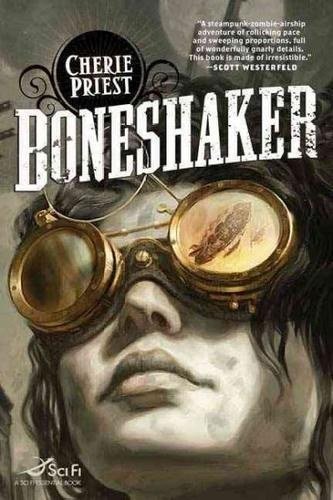
Cherie Priest's Boneshaker gives steampunk a Seattle full of toxic gas, sealed streets, family ghosts and zombies, which is one way to discourage casual tourism.
Boneshaker opens Cherie Priest's Clockwork Century sequence and is one of the major modern American steampunk novels. Its setting is an alternate-history Seattle, walled off after a catastrophic machine accident releases the Blight, a toxic gas that turns people into the undead rotters. That premise gives the book an immediate identity: industrial disaster, urban quarantine, family history and survival horror in a Civil War-era world.
The Boneshaker machine itself matters because it makes technology the origin of catastrophe. Steampunk inventions are often charming, useful or heroic. Priest's great machine is remembered for damage. That shifts the genre toward industrial consequence. The marvellous device does not simply open a frontier; it poisons a city and leaves ordinary people to live with the aftermath.
The Seattle setting is important too. Much steampunk defaults to London, Paris or invented European capitals. Boneshaker moves the field into American geography and Weird West territory, with frontier energy, Civil War shadows and Pacific Northwest gloom. That broadens the map and helps establish that steampunk is not only British Victoriana in a taller hat.
The novel follows Briar Wilkes and her son Zeke, whose family history is tied to the disaster. This family angle grounds the horror and machinery. The story is not just about a poisoned city but about inherited guilt, reputation and survival. In steampunk terms, that is useful: the machine's consequences pass through households as well as streets.
Briar is one of the reasons the book has staying power. She is not an explorer arriving to marvel at ruins. She has history with the place, and that history is painful. Steampunk often sends outsiders into strange zones; Boneshaker sends someone back toward a disaster that has shaped her life. That return gives the ruined city emotional gravity.
Zeke's movement into the walled city adds the young-adventure thread, but Priest keeps the danger harsher than a simple coming-of-age tour. The city is not a playground. It is a damaged urban organism full of rotters, scavengers and poisonous air. The result is adventure with a respirator, which feels entirely proper.
The zombies, or rotters, place the book in horror-steampunk territory, but they are not random garnish. They are part of the industrial ecology of the ruined city. Toxic gas, sealed environments, scavengers and undead bodies all belong to the same disaster system. That makes the book feel more integrated than a simple "steampunk plus zombies" pitch might suggest.
Boneshaker is essential because it marks the American Weird West branch at a high point of visibility. It combines alternate history, machinery, frontier grit, urban survival and horror in a way that became a touchstone for modern steampunk readers. It is not genteel. It has dirt under its nails and gas in its lungs.
It also connects to the broader Maker & Masquerade Age because it arrived when steampunk was becoming culturally prominent. Yet it resists the cleaner costume-party version of the mode. Its world is damaged, improvisational and dangerous. If someone is wearing goggles here, they probably need them.
The Civil War-era background also gives the book a different American historical pressure from the usual Victorian empire model. The conflict is not the same as British imperial adventure, and the machinery does different cultural work. Priest's steampunk feels frontier-adjacent, urban, ruined and improvisational, which is why it broadens the canon rather than merely relocating it.
Its popularity also helped make modern American steampunk feel commercially and aesthetically distinct. Here the field's materials are not only parlours and laboratories, but walls, masks, scavenged mechanisms and a city that has become a wound. The result is a grittier modern landmark.
The book is also useful for theme links on environmental hazard. The Blight makes technology's damage atmospheric, something breathed rather than merely observed. That is a sharp metaphor for industrial consequence, and Priest gives it zombies just to make sure nobody misses the point.
Is it really steampunk?
Yes. Boneshaker is Weird West steampunk and a core modern entry. Its alternate Civil War-era setting, catastrophic machinery, toxic urban environment, air of scavenged technology and horror elements make it unmistakably part of the field.
Its importance lies in geography and consequence. Priest gives steampunk an American setting that does not feel like imported London fog. She also treats invention as disaster, not merely wonder. That makes the novel useful beside works like Mortal Engines and Perdido Street Station, where city, machine and social harm are tangled together.
Readers looking for polite brass adventure should brace themselves. Boneshaker is grubbier, heavier and more haunted. That is exactly why it belongs. Steampunk without ruined cities and bad air would be suspiciously well ventilated.
Find it
If you would like to track down Boneshaker, these search links may help. We have not specified an edition, so you can pick the format that suits you.
Affiliate links: as an Amazon Associate, Stephen Hunt’s SFcrowsnest earns from qualifying purchases. These may earn us a small commission at no extra cost to you.