
Why it matters
It turns Twain, Halley's Comet and nineteenth-century literary imagination into a strange, handmade retrofantasy voyage.
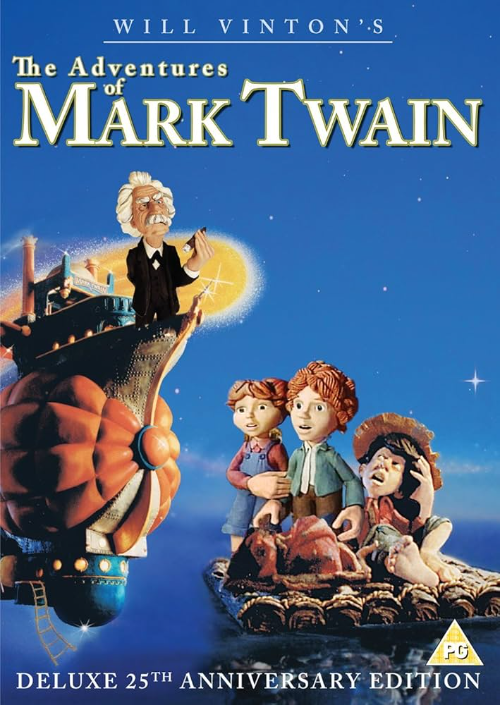
Will Vinton's The Adventures of Mark Twain sends Samuel Clemens into the sky in a clay airship, which is a pleasingly odd way to make American literature look as if it has mislaid its railway timetable.
The film is a stop-motion, clay-animated feature from Will Vinton, built around Mark Twain, the children from his fiction and a voyage connected to Halley's Comet. Twain famously arrived and departed near appearances of the comet, and the film uses that biographical flourish as the frame for a floating, episodic journey through his imagination.
Its steampunk fit begins with the airship. The vessel is not there as military hardware or engineering speculation. It is a literary contraption, a stage on which Twain's stories, moods and darker jokes can pass by. That makes the film less core steampunk than retrofantasy, but the machinery is still important. It gives the nineteenth-century author a vehicle worthy of myth.
The clay animation gives everything a particular texture. Nothing is slick. Faces flex, objects wobble slightly, and the world feels handmade in a way that suits the material. Steampunk often loves visible construction, and Vinton's film supplies that at the level of animation itself. You can almost feel the fingerprints under the wit.
The tone is stranger than many family viewers expect. Twain is funny, but he is also morbid, sceptical and haunted by the cosmic joke. The film remembers that his work had shadows. The result is not a simple children's adventure with a famous author pasted on. It is more like being taken through a literary funhouse by a guide who has read the final chapter and is not entirely comforted by it.
That darkness is one reason the film has lingered as a cult object. It does not flatten Twain into a kindly classroom statue. It lets him be mischievous, contradictory and occasionally alarming. For a retrofantasy entry, that is valuable. The past is not only quaint furniture and amusing hats. It is also full of strange ideas, death jokes and people staring at eternity with their eyebrows raised.
That is where its field value lies. It connects to Vernean and Wellsian screen ancestors by using a historical literary figure as the engine for impossible travel, but it is American, comic and philosophical in a different key. The airship does not promise empire or conquest. It carries argument, satire and a man's complicated appointment with the heavens.
It also sits near Time Bandits in its refusal to make historical fantasy tidy. Both films let the past behave badly, and both understand that childhood adventure can contain real unease. The Adventures of Mark Twain is gentler in some places and more startling in others, especially when it turns towards Twain's darker reflections.
As an animated object, it also gives the field something outside the normal live-action lineage. Steampunk and retrofantasy are often discussed through sets, props and costumes, but animation can build impossible nineteenth-century worlds with different tools. Here the airship, faces and landscapes are all sculpted performance. That makes the film feel related to mechanical theatre as much as to cinema.
Purists may object that an airship alone does not make steampunk. Correct, and the film is not core steampunk. Its importance is as a literary retrofantasy cousin, one that shows how nineteenth-century figures, mechanical vehicles and handmade spectacle can become part of the genre's wider atmosphere.
Is it really steampunk?
It is steampunk-adjacent rather than core steampunk. The airship, historical literary frame, nineteenth-century imagination and handmade retrofantasy texture place it near the field, while the film's real centre is Twain's wit, melancholy and myth.
Viewers should come for a deep cut: odd, thoughtful, sometimes eerie and very much its own object. It has an airship, but it is less interested in conquest than in giving Mark Twain a last strange ride.
Find it
If you would like to track down The Adventures of Mark Twain, these search links may help. We have not specified an edition, so you can pick the format that suits you.
Affiliate links: as an Amazon Associate, Stephen Hunt’s SFcrowsnest earns from qualifying purchases. These may earn us a small commission at no extra cost to you.