
Why it matters
It is one of the clearest early steampunk video games, turning late-nineteenth-century industrial war machines into a side-scrolling arcade spectacle of aircraft, battleships and smoke-belching hardware.
Steel Empire is the steampunk shooter that looked at biplanes, dirigibles, steam trains and giant guns, then decided subtlety could stay home and polish the teaspoons.
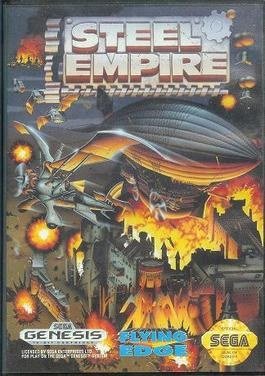
Released for the Sega Genesis in 1992, Steel Empire is a horizontally scrolling shooter with an unusually strong steampunk identity. Its world is a late-nineteenth-century alternate theatre of mechanised conflict. The player flies steam-era aircraft against industrial enemies, armoured trains, battleships and bosses built with enough riveted menace to make the background art nervous.
The important thing is how direct it is. Many early games are steampunk-adjacent only in retrospect, carrying one or two motifs from older scientific romance. Steel Empire is not coy. Its steam aircraft, propellers, dirigibles, cannons and heavily armoured machines make the genre visible at a glance. This is not merely a fantasy game with an airship tucked into the corner. It is arcade steampunk as a total visual proposition.
That visual force matters because video games often teach genre through silhouette before they teach it through text. A player does not need a lecture on Victorian alternate technology to understand Steel Empire. The machines announce themselves. The aircraft look like they belong to a world that industrialised sideways, with brass, smoke and a military budget that no one in finance was brave enough to question.
Its place beside works such as The Chaos Engine is especially useful. Both are early 1990s games that take steampunk out of prose and into fast action. The Chaos Engine is top-down, grimy and British, a run-and-gun scramble through a broken Victorian timeline. Steel Empire is more aerial, more arcade-bright and more openly fascinated by military hardware. Together they show how quickly steampunk could become playable style.
The Japanese origin also matters. Steampunk has never been only a British or American inheritance. Japanese animation and games repeatedly reworked airships, ruins, engines, militarism and industrial fantasy into distinct visual languages. Castle in the Sky and later Steamboy are obvious landmarks in animation. Steel Empire belongs to the game side of that story, proving that the same appetite for flying machines and ornate conflict could fit a shooter cartridge.
The game's war setting gives the machinery bite. This is not cosy maker-culture steampunk or drawing-room intrigue. It is industrial conflict rendered as scrolling hazard. The machine is thrilling because it is dangerous, because it fills the screen, because the player is one small moving point in a world of engineered violence. That makes it less reflective than literary steampunk, but not less important.
Steel Empire earns its place by being unmistakable. It is not a footnote that needs special pleading. It looks at the player through a cloud of exhaust and asks whether they would prefer a plane or an airship. The answer, obviously, is whichever one survives the next boss.
Is it really steampunk?
Yes. Steel Empire is core arcade steampunk: steam aircraft, dirigibles, industrial war machines, late-nineteenth-century alternate-world styling and side-scrolling mechanical spectacle.
It suits players who want the genre at speed, with fewer salons and considerably more incoming fire.
Find it
If you would like to track down Steel Empire, these search links may help. We have not specified an edition, so you can pick the format that suits you.
Affiliate links: as an Amazon Associate, Stephen Hunt’s SFcrowsnest earns from qualifying purchases. These may earn us a small commission at no extra cost to you.