
Why it matters
It is a late-1990s Japanese game built around mysterious machinery, ornate devices and robot-like armour, placing it near the clockwork and ancient-technology edge of steampunk-adjacent gaming.
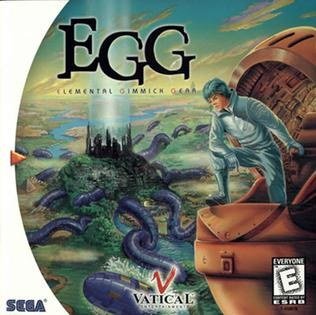
Elemental Gimmick Gear is a Dreamcast RPG with ancient machinery, mysterious armour and a title that sounds as if three inventors argued over the label and all won.
Developed by Birthday and released for the Dreamcast in 1999, Elemental Gimmick Gear follows a hero connected to an ancient mechanical suit, the titular E.G.G. The game mixes action-RPG exploration with a world of ruins, devices and technology whose origins feel older and stranger than the present. It is not one of the most famous steampunk-adjacent games, but it has exactly the sort of machinery-haunted atmosphere that makes the borderlands interesting.
The ancient suit is the central object. Steampunk often loves wearable machinery because it puts invention on the body. Armour, prosthetics, diving gear and exoskeletons all turn technology into identity. Elemental Gimmick Gear uses the E.G.G. suit in that broad family, making mechanical inheritance part of the character's way through the world.
Its aesthetic is not Victorian, and that matters. Like many Japanese works near the steampunk field, it draws from clockwork, anime fantasy, ruins and speculative machinery rather than British industrial history. The result is less gaslamp and more ornate-machine fantasy. It sits nearer Nausicaa of the Valley of the Wind and Skies of Arcadia than to The Difference Engine.
The game's Dreamcast context also gives it a place in a particular moment of hardware optimism. Around the turn of the millennium, games were increasingly able to present elaborate worlds, mechanical environments and hybrid genre spaces with more visual personality. Elemental Gimmick Gear belongs to that transition, when old RPG structures could be dressed in stranger apparatus.
Its title word "gimmick" is oddly appropriate. In game design, a gimmick can mean a central device, a hook, a mechanical identity. Steampunk itself is full of gimmicks in the older, more affectionate sense: mechanisms that attract attention, invite curiosity and promise that something will happen if touched. The E.G.G. suit works that way. It is a premise you can move around in.
Compared with Myst, the game is much more character-driven and action-focused. Compared with Skies of Arcadia, it is less sweeping and less airship-romantic. Its appeal is smaller and stranger: ancient machinery as personal destiny, a world full of mechanical secrets, and the mild pleasure of a game that seems built from brass-adjacent mystery without becoming a brass catalogue.
As a deep cut, it shows how widely the motifs spread. Not every relevant title changes the genre. Some simply offer old machines, lost civilisations, ornate armour, puzzle-like technology and the sense that the past has left hardware waiting for the future to trip over.
Is it really steampunk?
Adjacent. Elemental Gimmick Gear is clockwork and ancient-machine fantasy rather than core steampunk, but its ornate mechanisms, robot-like suit and lost technology sit comfortably near the field.
It suits players interested in obscure Dreamcast RPGs and the quieter mechanical corners of anime-adjacent fantasy.
Find it
If you would like to track down Elemental Gimmick Gear, these search links may help. We have not specified an edition, so you can pick the format that suits you.
Affiliate links: as an Amazon Associate, Stephen Hunt’s SFcrowsnest earns from qualifying purchases. These may earn us a small commission at no extra cost to you.