
Why it matters
It gives the wider retrofuturist field one of its great ecological epics, where flying machines and ruined civilisation answer to the natural world.
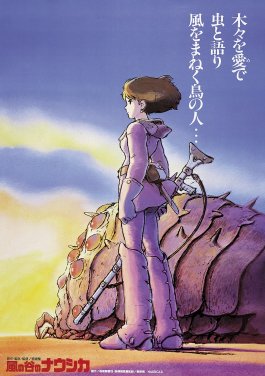
Hayao Miyazaki's Nausicaa of the Valley of the Wind begins with poisoned landscapes, armed kingdoms and aircraft that look as if they have been designed by someone who loves flight and distrusts anyone who enjoys war.
Miyazaki's Nausicaa manga began in 1982 and ran for years, expanding far beyond the famous animated film. Its world is post-apocalyptic, marked by the toxic Sea of Corruption, giant insects, warring kingdoms and remnants of older technological disaster. It is not steampunk, but it sits close to the border where airship adventure, ecological SF and retro-military design meet.
The machinery is important, especially the aircraft. Miyazaki has one of the great visual imaginations for flight: gliders, gunships, transport craft and fragile machines that feel simultaneously practical and lyrical. In steampunk and diesel-adjacent fiction, flying machines often represent freedom or power. In Nausicaa, they also reveal fragility. The sky is beautiful, but the world below is wounded.
The ecological centre makes the work much richer than simple adventure. The toxic forest is not merely a monster zone. It is part of a larger environmental system, one that human politics fails to understand because human politics is busy shouting and sharpening things. Nausicaa's gift is not that she can defeat nature, but that she can listen to it.
That makes the manga useful beside works like Mortal Engines and Castle in the Sky. All three are concerned with ruins, machines, power and the inheritance of earlier catastrophe. Miyazaki's emphasis is more ecological and spiritual, but the shared question remains: what do people do with the remains of a technological age they barely understand?
The diesel-adjacent label fits better than steampunk because the visual language leans toward aircraft, war machines, post-apocalyptic militarism and twentieth-century anxieties rather than steam-age invention. Yet it belongs on this map because steampunk's wider family includes works that use retro machines to ask what civilisation has broken.
Nausicaa herself is not simply a warrior princess or a saintly nature mascot. She is curious, brave, angry, compassionate and politically trapped. That complexity keeps the ecological message from becoming a poster. The manga understands that care is difficult work, especially when everyone else is busy turning fear into policy.
The manga's longer form gives Miyazaki room to complicate the world far beyond the film. Alliances shift, histories deepen and the moral questions grow thornier. For readers who only know the animated version, the manga can feel like discovering the engine room beneath a beautifully painted aircraft.
That extra depth matters for this map because the work's machines are never isolated from ecology. Every aircraft flies over a world that is trying, in its own alarming way, to heal.
That tension gives the flying scenes their sorrow as well as their beauty.
Is it really steampunk?
No. Nausicaa of the Valley of the Wind is eco-fantasy and post-apocalyptic science fantasy, with diesel-adjacent aircraft and retro-military design. Its relationship to steampunk is one of kinship, not identity.
Readers interested in airships, ruined worlds, ecological consequence and machine-age melancholy should still treat it as a landmark. It widens the field by reminding us that machines are not the only wonders in the world, and may not even be the cleverest ones.
Find it
If you would like to track down Nausicaa of the Valley of the Wind, these search links may help. We have not specified an edition, so you can pick the format that suits you.
Affiliate links: as an Amazon Associate, Stephen Hunt’s SFcrowsnest earns from qualifying purchases. These may earn us a small commission at no extra cost to you.