Why it matters
It is a short-lived but revealing pre-steampunk-label example of the scientist-adventurer solving crimes with gadgets, reason and period style.
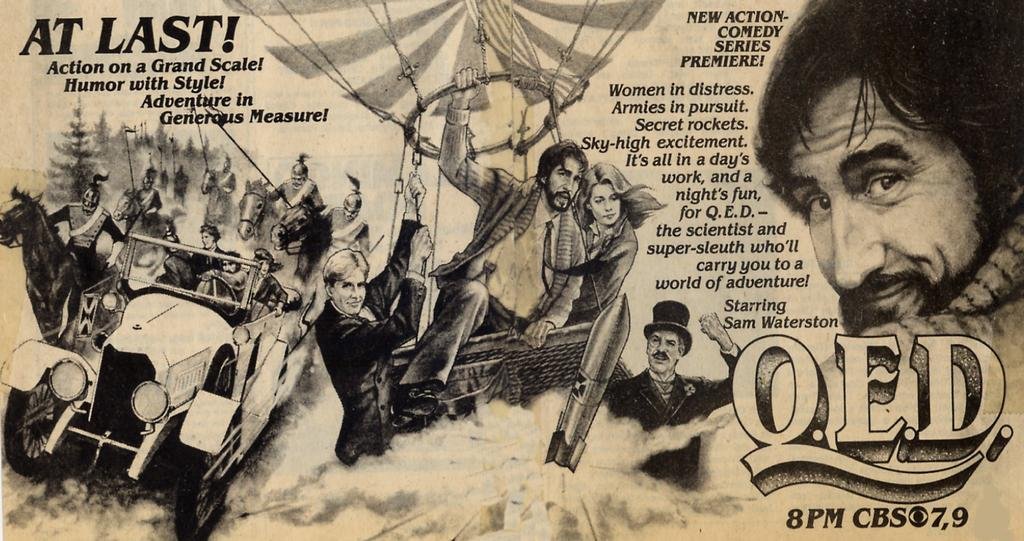
Q.E.D. is the sort of television oddity that sounds as if someone found Sherlock Holmes, a science kit and an Edwardian wardrobe in the same prop room and decided to be brave.
The American series starred Sam Waterston as Quentin E. Deverill, an Edwardian-era scientific detective whose initials supply the title and a small air of Latin certainty. The show mixed crime plots, invention, espionage flavour and period adventure, arriving at a moment when steampunk as a named literary category was only just beginning to gather its public shape.
That timing makes it more interesting than its brief run might suggest. Q.E.D. is not remembered as a major genre landmark, and it did not become a long-running cult machine. Yet it belongs in the prehistory because it uses a familiar steampunk-adjacent figure: the rational inventor hero, armed with devices and curiosity, moving through an early modern world where science still looks a little theatrical.
The Edwardian setting is also useful. Classic steampunk often gravitates towards Victorian Britain, but the years just after Victoria provide their own flavour: motorcars, telephones, electricity, aeronautic dreams, imperial unease and the sense that modernity has put on a fresh collar. Q.E.D. draws from that transitional mood, even if television budgets kept the machinery from becoming too extravagant.
Its comparison points are clear. Like Sherlock Holmes, it uses detection, cleverness and period urbanity. Like The Wild Wild West, it likes the idea of adventure plots enlivened by gadgetry before the genre has fully named itself. Later shows such as The Secret Adventures of Jules Verne would make the retro-invention premise more explicit and more lavish.
The series' obscurity is part of its catalogue value. Not every ancestor arrives with a brass plaque and a line of cosplayers. Some arrive as cancelled television, leaving behind a useful sketch of what the culture was prepared to try. Q.E.D. shows that period science-adventure was already television material before the modern steampunk boom turned it into a more recognisable wardrobe.
It also helps separate two related pleasures. One is steampunk world-building, where technology transforms society. The other is science-detective adventure, where a clever protagonist uses devices to disturb a familiar historical setting. Q.E.D. is much more the second. That makes it lighter, less comprehensive and still worth cataloguing.
The title's greatest value may be as a missing link for television habits. It shows producers already experimenting with the appeal of a clever scientific hero in period dress, a format that later retro-adventure would revisit with more confidence and shinier production design. The short run limits its cultural footprint, but the idea is clear enough: science can be a detective's method, a magician's flourish and a marketing hook all at once.
For modern viewers, the pleasure is likely archival rather than essential. This is not the first recommendation for anyone wanting the field at full pressure. It is more like finding an early prototype in a drawer and realising the design problem had been bothering people for years.
Is it really steampunk?
Not quite. Q.E.D. is proto-steampunk and science-detective television rather than core steampunk. Its importance lies in the Edwardian inventor hero, gadget plots, crime-solving structure and early attempt to turn period science into adventure television.
It is a deep cut for viewers who enjoy the ancestry of the field: not the fully built machine, but one of the interesting little mechanisms left on the workbench.
Find it
If you would like to track down Q.E.D., these search links may help. We have not specified an edition, so you can pick the format that suits you.
Affiliate links: as an Amazon Associate, Stephen Hunt’s SFcrowsnest earns from qualifying purchases. These may earn us a small commission at no extra cost to you.