
Why it matters
It is one of the most influential Dungeons & Dragons settings for steampunk-adjacent play, replacing steam with industrialised magic while keeping the trains, airships, pulp danger and social consequences.
Eberron answers the question "what if a fantasy world industrialised through magic?" and then sensibly adds trains, airships, living constructs and enough intrigue to keep everyone employed.
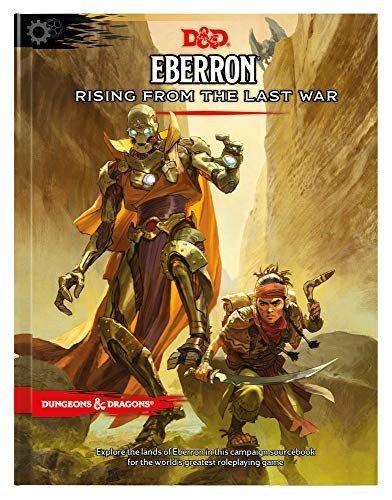
Created by Keith Baker and published by Wizards of the Coast, Eberron presents a fantasy world shaped by magical industry. Lightning rails, elemental airships, dragonmarked houses, warforged soldiers and postwar intrigue give the setting a modernising energy distinct from more medieval D&D worlds.
The usual label is magepunk rather than steampunk, and that distinction matters. The technology is powered by magic, not steam engineering. Yet the social function is closely related: transport networks, industrial production, corporate power, veteran trauma, espionage and urban modernity all give the setting a machine-age feel.
The lightning rail is the clearest symbol. Steampunk loves trains because they combine infrastructure, speed, class and danger. Eberron gives fantasy its own version, powered by bound elemental force rather than coal. The result is not Victorian technology, but it performs a similar imaginative job.
Warforged add a second crucial element. Living constructs created for war bring questions of personhood, labour, trauma and postwar society into the setting. That places Eberron near many steampunk works concerned with artificial bodies, military invention and what happens when a weapon survives the war it was built for.
The pulp tone keeps it lively. Eberron is not only infrastructure and political theory. It is a place for spies, explorers, noir investigators, dragonshard smugglers and people making bad decisions on airships. That adventurous speed is part of why the setting became so beloved.
Its adjacency to Iron Kingdoms is useful. Both settings move steampunk concerns into fantasy gaming, but Eberron is more urban, magical and intrigue-driven, while Iron Kingdoms is more militarised and wargame-heavy. Together, they show how broadly the genre's machinery can travel.
The Last War gives the setting its emotional pressure. Airships and lightning rails are exciting, but the world is also full of veterans, ruined nations, espionage and weapons that no longer have a clear war to serve. That postwar atmosphere keeps the magic-industrial setting from becoming a theme park of clever devices.
Sharn, the City of Towers, is especially important. It gives the setting a vertical metropolis of class, crime, trade and intrigue, which is often where steampunk-adjacent fantasy becomes most alive. Transport, architecture and social hierarchy all stack together, sometimes literally.
For players, Eberron is attractive because it lets D&D behave like pulp noir, espionage, expedition fiction and magical industrial drama without leaving the familiar rules family. It is a gateway setting, and gateway settings matter.
The dragonmarked houses add another important layer. They make magic feel corporate, hereditary and infrastructural rather than purely heroic. That is one of the setting's sharpest modern touches. Power is not only in spells and swords; it is in transport contracts, communication networks and families with monopolies.
Its steampunk adjacency is therefore structural. Swap steam for arcane power and the same questions keep appearing: who controls the rails, who built the soldiers, who profits from war, and who gets left in the lower districts when the towers rise. That is rich material for fantasy play.
Is it really steampunk?
Adjacent. Eberron is magepunk fantasy, not classic steampunk. Its relevance comes from lightning rail, airships, warforged, magical industry, pulp intrigue and the social effects of industrialised power.
It belongs near the field because it understands that infrastructure changes stories. Once the train is running, the world is not the same, even if the boiler has been replaced by an elemental.
Find it
If you would like to track down Eberron, these search links may help. We have not specified an edition, so you can pick the format that suits you.
Affiliate links: as an Amazon Associate, Stephen Hunt’s SFcrowsnest earns from qualifying purchases. These may earn us a small commission at no extra cost to you.