Why it matters
It is a major steam-fantasy gaming setting, especially through its connection to Warmachine, bringing warjacks, mechanika, magic industry and military spectacle into the steampunk-adjacent orbit.
Iron Kingdoms is what happens when fantasy warfare discovers heavy industry and immediately starts building enormous metal friends with battlefield applications.
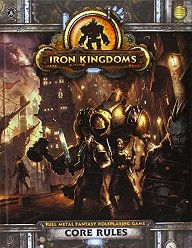
Published by Privateer Press, Iron Kingdoms developed as both roleplaying setting and wargame world, with Warmachine making its steam-powered war machines especially visible. The setting mixes fantasy nations, divine politics, industrialised magic, mechanika and battlefield machines known as warjacks.
The steampunk fit is adjacent because this is not Victorian alternate history. It is fantasy wargame industrialism: boilers, magic, armour, cannons, priests, mercenaries and machines built to hit other machines until the table looks expensive. That still places it very close to steampunk because industrial machinery is central to the world's identity.
Warjacks are the obvious hook. They are not merely monsters with rivets. They represent a world where magical and mechanical knowledge has been militarised, industrialised and made commercially useful. Steampunk often worries about invention becoming war. Iron Kingdoms begins with that problem already wearing armour.
The wargame crossover matters because it changes the kind of steampunk-adjacent experience on offer. Novels and films show machines. Tabletop wargames ask players to collect, paint, deploy and tactically manage them. The machine becomes a physical object on the table, not just a description in a paragraph.
The setting also belongs near Eberron. Both are fantasy worlds where magic has become infrastructure. Eberron leans pulp and arcane modernity, while Iron Kingdoms leans heavier, smokier and more martial. Both show how steampunk ingredients can migrate into fantasy gaming without needing Queen Victoria to supervise.
Its audience is the player who likes big metal silhouettes, national conflict, industrial magic and the satisfying feeling that diplomacy has failed in a mechanically interesting way. It is not subtle steampunk, but it is forceful, and force has always had a place in game-world design.
The setting's visual identity is one of its strengths. Warjacks are chunky, readable and built for the table, which makes the industrial fantasy immediately legible. Players do not need a lecture on mechanika when a towering steam-powered war machine is standing there with a weapon larger than a municipal problem.
The religious and national politics add useful texture. Iron Kingdoms is not only about machines fighting machines. It is a world of states, faiths, mercenaries and industrial pressures colliding. That makes the machinery part of a wider society rather than a detached toybox.
It also shows how steampunk-adjacent design thrives in miniatures culture. A painted model can sell a setting's logic in an instant: smoke, armour, rivets, banners and battlefield purpose. That physicality gives Iron Kingdoms a different sort of canon presence from purely textual games.
The setting's magic is also pleasingly workmanlike. It is not only prophecy and glowing destiny. It has been engineered, monetised, militarised and fitted to armour. That turns fantasy power into industry, which is why the world feels close to steampunk even when its roots are firmly in secondary-world gaming.
For roleplayers, the appeal goes beyond the battlefield. Mercenary contracts, national borders, churches, workshops and political rivalries all create adventure hooks. The warjack may be the poster image, but the world around it has enough machinery, literal and social, to keep a campaign busy.
Is it really steampunk?
Adjacent. Iron Kingdoms is steam fantasy rather than classic steampunk. Its relevance comes from mechanika, warjacks, industrial magic, boilers, militarised invention and the wargame culture around them.
It belongs near the field because it asks what happens when fantasy stops waving wands delicately and starts manufacturing war engines.
Find it
If you would like to track down Iron Kingdoms, these search links may help. We have not specified an edition, so you can pick the format that suits you.
Affiliate links: as an Amazon Associate, Stephen Hunt’s SFcrowsnest earns from qualifying purchases. These may earn us a small commission at no extra cost to you.