
Why it matters
It made Columbia one of gaming's major floating cities, combining early twentieth-century Americana, impossible sky architecture, mechanical spectacle and political rot.
BioShock Infinite sends American exceptionalism into the clouds, which is an ambitious way to make a floating city and a political argument share the same altitude sickness.
Developed by Irrational Games and released in 2013, BioShock Infinite is set in Columbia, a city floating above the United States in 1912. The player arrives as Booker DeWitt, searching for Elizabeth and soon discovering that Columbia's patriotic pageantry hides violence, racism, class conflict, religious cultism and quantum complications. The clouds, it turns out, are not an ethical improvement.
The game is not straightforward steampunk. Its period is later, its visual language draws on Americana, diesel-age militarism and carnival spectacle, and its science-fiction machinery leans toward quantum weirdness. Yet it belongs in the steampunk-adjacent field because of its floating city, retrofuturist technology, sky-lines and alternate technological history.
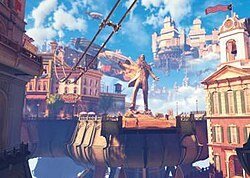
Columbia is the central invention. Floating cities have a long speculative history, from utopian fantasies to airborne fortresses. BioShock Infinite makes the floating city a national myth turned weapon. The architecture is bright, clean and grand on the surface, but the political machinery beneath it is rancid. That contrast gives the game its strongest bite. The city flies, but it does not rise morally.
The sky-lines turn movement into spectacle. Players hook onto rails and swing through the city, making vertical space part of combat and traversal. Steampunk loves transport systems because they reveal how worlds are organised: railways, airships, trams, lifts and pneumatic tubes all imply social order. Columbia's sky-lines are infrastructure as thrill ride, which is exactly the sort of thing a floating propaganda city would consider normal.
Its relationship to Castle in the Sky and Skies of Arcadia is useful because all three build worlds around altitude. Miyazaki's film treats flight as wonder shadowed by military ambition. Skies of Arcadia treats it as heroic freedom. BioShock Infinite treats it as ideology, spectacle and control. Same sky, very different weather.
Elizabeth's role also shifts the game beyond machinery. Her reality-tearing powers introduce parallel worlds, narrative loops and metaphysical instability. That makes the game's science fiction less industrial than many steampunk works, but it strengthens the sense of a world built on impossible systems. Columbia is not only mechanically unlikely. It is ontologically troublesome.
The game's politics have been argued over at length, but its visual importance remains. It brought a spectacular floating-city retrofuture to a huge mainstream audience, with airships, mechanical patriots, fairground surfaces and ugly national fantasies all colliding. Steampunk-adjacent games often ask whether old futures can expose old sins. BioShock Infinite answers by putting the sins on parade.
The fairground texture is part of that argument. Columbia sells itself constantly: through banners, songs, pageants, exhibits and curated spectacle. That makes the city feel less like a neutral setting and more like a propaganda machine with nice lighting. The prettiness is not a softening agent. It is part of the trap.
Is it really steampunk?
Adjacent. BioShock Infinite is closer to dieselpunk and retrofuturist alternate history than core steampunk, but Columbia's floating city, mechanical spectacle, sky-lines and period machinery make it impossible to ignore.
It suits players who like their airborne wonders bright, troubling and heavily overinvested in flags.
Find it
If you would like to track down BioShock Infinite, these search links may help. We have not specified an edition, so you can pick the format that suits you.
Affiliate links: as an Amazon Associate, Stephen Hunt’s SFcrowsnest earns from qualifying purchases. These may earn us a small commission at no extra cost to you.