Why it matters
It is a compact and stylish Weird West game, mixing western revenge imagery with robots, mechanical bosses and arcade shooting in a form that makes steampunk instantly playable.
Wild Guns is a cowboy revenge shooter with robots, which is an admirably direct way of improving the frontier's mechanical literacy.
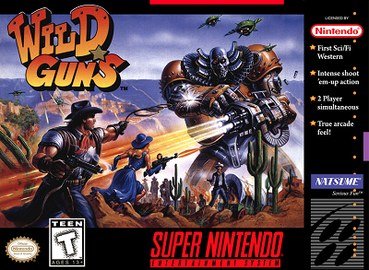
Released by Natsume for the Super Nintendo in 1994, Wild Guns is a gallery-style shooter built around Clint and Annie, bounty-hunting heroes in a western world crowded with robots and heavy machinery. The premise is wonderfully economical. There is a frontier, there is revenge, and there are machines that absolutely should not be permitted near a saloon.
The game belongs to the Weird West branch of steampunk. Instead of London fog, brass salons or imperial laboratories, it uses frontier imagery: guns, dust, towns, outlaws and showdowns. Then it adds robots and mechanical weapons until the whole thing becomes a fast, colourful argument for industrial absurdity. It is the same broad family that makes Deadlands and Wild Wild West relevant, though Wild Guns has the brisk manners of an arcade game rather than a lore-heavy setting.
Its importance lies in clarity. Some works need paragraphs to explain why they count. Wild Guns needs one screenshot. Cowboys dodge bullets while machines loom in the background and bosses clank into view. The mixture is immediate, readable and cheerfully unembarrassed. It treats the western and the robot not as opposites but as dance partners with poor safety standards.
The Japanese origin gives it an extra charge. Western imagery has often travelled globally as a set of signs: hats, guns, desert towns, revenge plots, heroic poses. Wild Guns remixes those signs through arcade design and anime-adjacent mechanical spectacle. The result is not historical America. It is a toybox frontier, stylised enough to let robots stride in without apologising to the sheriff.
Mechanically, the game also shows how steampunk can work through action rhythm. This is not a roleplaying world of factions and social structure. It is movement, aiming, dodging, explosions and screen-filling threats. The machinery matters because it changes the feel of the fight. A robot enemy is not just a visual joke; it alters scale, pattern and pressure.
That makes it a useful partner to Steel Empire. Both games turn steampunk into arcade language. Steel Empire goes aerial and military, with steam aircraft and battleships. Wild Guns keeps boots in the dust and puts machines behind the guns. Together they show how early 1990s games could make retro-futurist machinery kinetic rather than contemplative.
The title also reminds us that steampunk's western branch does not have to be grim. Deadlands leans into horror and occult danger. Wild Guns is brighter, faster and more straightforwardly comic-book in its pleasures. It is not less steampunk for being energetic. Sometimes the genre arrives as a scholarly argument; sometimes it kicks open a swinging door and starts firing at a robot.
Is it really steampunk?
Yes, in Weird West form. Wild Guns combines western revenge, robots, mechanical bosses, frontier technology and arcade spectacle into a clean steampunk blend.
It suits players who like the frontier with extra metalwork and no patience for anyone explaining why a robot is standing in the street.
Find it
If you would like to track down Wild Guns, these search links may help. We have not specified an edition, so you can pick the format that suits you.
Affiliate links: as an Amazon Associate, Stephen Hunt’s SFcrowsnest earns from qualifying purchases. These may earn us a small commission at no extra cost to you.