
Why it matters
It helped show that steampunk could be knowingly comic, literary, rude, satirical and postmodern rather than only earnest alternate history.
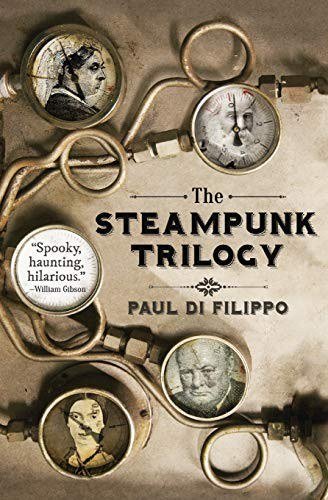
Paul Di Filippo's The Steampunk Trilogy arrives with the air of a book that has read the canon, raided the costume cupboard and decided the sensible next step is to misbehave in public.
The Steampunk Trilogy is not a trilogy in the grand doorstop sense but a collection of three novellas, each taking Victorian or near-Victorian materials and sending them through Di Filippo's gleefully destabilising machinery. Queen Victoria, Lovecraftian weirdness, scientific invention and literary parody all get their turn. The result is core steampunk, but not the tidy brass sort that wants you to admire the upholstery.
This is steampunk with a smirk and a sharp elbow. By 1995, the genre had already acquired landmarks in Jeter, Powers, Blaylock, Gibson and Sterling. Di Filippo comes along and treats the field as something ripe for play, exaggeration and mockery. That is valuable. Genres become healthier when they can laugh at their own furniture before the furniture becomes sacred.
The collection's title is unusually important because it helped put the word "steampunk" directly on a literary object during the canon-forge period. The term had already been coined as a joke, but books like this helped make it visible as a label readers could recognise. The joke did not vanish. It became part of the label's energy.
The spreadsheet's motifs, Queen Victoria, Lovecraft and madcap neo-Victorian parody, point toward the book's method. It takes historical and literary icons, not as relics, but as ingredients for extravagant remix. This places it near Anno Dracula and The League of Extraordinary Gentlemen, though Di Filippo's tone is more anarchic and satirical.
That satirical mode matters because steampunk is always at risk of becoming too reverent toward the past it is reworking. Reverence can polish away the absurdity, violence and weirdness that make the material interesting. The Steampunk Trilogy keeps the absurdity alive. It knows that Victorian respectability was already theatrical, so the sensible response is to turn up the theatre until something strange falls out.
The Lovecraftian strand also connects the collection to New Weird and weird-fiction borderlands. Steampunk often works by putting technology where magic or horror might be expected, but it can also invite cosmic wrongness into the parlour. Di Filippo's willingness to cross wires between literary traditions makes the book a useful bridge between comic steampunk and stranger speculative modes.
It also belongs to the tradition of counter-canon. The collection does not simply honour Victorian and pulp materials; it teases them, warps them and exposes their absurdity. That matters because steampunk can otherwise slide into museum reverence. Di Filippo treats history and literature as things to be played with vigorously, preferably while someone in authority is looking the other way.
There is a difference, though, between playful and careless. The jokes work because they know what they are joking about. A reader can feel the book's familiarity with genre history, with the grand old names and the embarrassing old assumptions. Its comedy is not random silliness. It is targeted genre misrule, and that gives it a proper place beside more serious canon entries.
For readers, this is not the best first stop if they want a straight explanation of the field. It is a better second or third stop, once the reader knows enough to enjoy the parody and the collisions. It rewards familiarity with Victorian icons, early steampunk habits and speculative fiction's appetite for clever disrespect.
Is it really steampunk?
Yes. The Steampunk Trilogy is core steampunk in a satirical, postmodern and comic register. Its use of neo-Victorian parody, historical figures, speculative invention and literary remix places it firmly inside the field, even though its tone is deliberately unruly.
Its value is that it stretches the canon sideways. Not every steampunk work needs to build a plausible alternate society. Some can expose the genre's assumptions through exaggeration. Some can turn the brass knobs until they squeal. Di Filippo's collection reminds us that steampunk was born partly as a joke and should not be ashamed of a well-aimed grin.
This entry belongs near the first-wave writers and the later literary remixers. It is a useful antidote to over-serious canon building, especially when steampunk starts polishing its own medals too solemnly.
It is also a good warning label. Anyone expecting steampunk to behave as a stable aesthetic category will find Di Filippo gleefully rearranging the shelves. The field is not only an arrangement of motifs. It is also an argument about how freely old materials can be repurposed, mocked and made strange again.
That freedom is why the collection remains more than a novelty. It catches steampunk at the moment when the genre is becoming aware of itself and immediately tests how elastic the new label can be. A canon needs monuments, but it also needs pranksters checking whether the monuments are hollow.
Find it
If you would like to track down The Steampunk Trilogy, these search links may help. We have not specified an edition, so you can pick the format that suits you.
Affiliate links: as an Amazon Associate, Stephen Hunt’s SFcrowsnest earns from qualifying purchases. These may earn us a small commission at no extra cost to you.