
Why it matters
It develops the Ministry series by tying agent adventure to suffrage politics, disappearances and peculiar technology.
The Janus Affair continues the Ministry of Peculiar Occurrences with secret agents, strange devices and suffragists, because no sensible steampunk ministry should assume that politics will stay politely outside the filing cabinet.
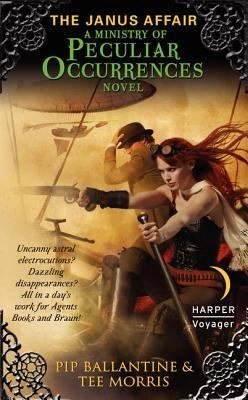
Following Phoenix Rising, The Janus Affair continues Pip Ballantine and Tee Morris's Ministry of Peculiar Occurrences series. The core pleasures remain: Eliza D. Braun, Wellington Books, secret investigations, gadgets and a world where the odd has become bureaucratically inconvenient. But this second entry brings suffragists and political disappearance into the frame, giving the adventure a sharper social thread.
The suffrage motif is important because steampunk set in or near Victorian culture cannot honestly ignore gender politics. Too many retro-adventures borrow the clothes and clubs of the period while leaving the political struggles in a cupboard. The Janus Affair brings women's public action and danger into its adventure structure, which makes it more useful than a simple gadget romp.
The title's Janus reference suggests doubleness, looking backward and forward, and that is a tidy metaphor for steampunk itself. The genre is always glancing both ways: back toward historical materials, forward toward speculative technologies and social alternatives. In this series, that double gaze becomes part of the agent machinery, where old institutions confront strange devices and changing politics.
Eliza and Wellington's partnership remains the series engine. Their contrast lets the books balance action and archive, fieldwork and research, explosion and explanation. Steampunk agent fiction needs both. Without the archive, the devices become arbitrary. Without the field agent, the archive becomes a very tidy way to be murdered.
The Janus Affair is a series continuation rather than the primary entry point. Phoenix Rising introduces the Ministry. This novel shows how the formula can take on a more explicit political case. That makes it a useful link for readers interested in suffrage, secret agencies and adventure steampunk with social stakes.
The strange devices continue to provide the visible steampunk texture. As with the first book, the machinery is there to serve investigation and danger rather than to construct a full alternate economy. That is typical of adventure steampunk, and it works when the pace and character dynamics carry the reader.
The suffragist disappearances give the machinery a political edge. If a device or conspiracy targets women involved in public activism, then the case is not merely peculiar; it is part of a struggle over who gets to speak and act in public life. That lifts the book above a purely mechanical puzzle and gives the Ministry a reason to look beyond its own filing system.
Eliza's presence is especially important in this context. A woman agent investigating danger around suffrage activism creates a sharper relationship between character and case than a more neutral investigator would have. The adventure can still be lively and gadget-filled, but the social stakes are not pasted on afterwards.
The Janus motif also suits series fiction. A second volume has to look backward to the first book while opening the path forward. This one continues the Braun and Books partnership while widening the kind of stories the Ministry can handle. That makes it a useful continuation page rather than a mere duplicate of Phoenix Rising.
The book also belongs beside Soulless and The Affinity Bridge as part of the accessible modern branch. These are works that helped make steampunk readable as ongoing entertainment: witty, case-driven, device-friendly and open to genre mixing. Not every entry needs to reinvent the airship. Some need to keep the ministry running.
Is it really steampunk?
Yes. The Janus Affair is core adventure steampunk, with secret agents, gadgets, Victorian-style institutions, suffrage politics and strange devices. It is series steampunk rather than a standalone canon monument, but that is a legitimate role.
Its particular value is the way it folds political activism into an adventure case. The suffragist material gives the book a stronger historical and social resonance than a purely mechanical mystery might have. It reminds the field that social change is one of the most important machines of the nineteenth and early twentieth centuries.
The best path is to start with Phoenix Rising and continue here. Once inside the Ministry, one can enjoy the mixture of banter, bureaucracy, danger and devices, while remaining alert to the fact that the peculiar occurrences are not always apolitical.
It also helps connect steampunk to suffrage themes, agent fiction and gadget-led adventure. The Ministry series may be built for entertainment, but this volume shows that entertainment can still let history knock firmly on the door.
That knock is the article's main reason for existing beyond simple series bookkeeping. It shows the Ministry formula taking on social struggle, not merely another oddity with brass edges and a dangerous hum.
Find it
If you would like to track down The Janus Affair, these search links may help. We have not specified an edition, so you can pick the format that suits you.
Affiliate links: as an Amazon Associate, Stephen Hunt’s SFcrowsnest earns from qualifying purchases. These may earn us a small commission at no extra cost to you.