
Why it matters
It extends one of steampunk's foundational lines into the modern boom, reconnecting new readers with Blaylock's eccentric Victorian machinery.
When James P. Blaylock sends Langdon St. Ives back into trouble, one expects Victorian manners, odd science, sinister acquaintances and the sort of object no sensible person would keep on a mantelpiece.
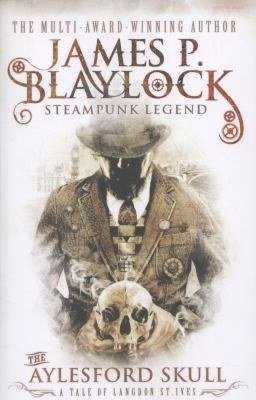
The Aylesford Skull is a late return to Blaylock's Langdon St. Ives material, which matters because Blaylock is not merely a visitor to steampunk. He is part of the first wave that helped give the word a literary body. Alongside Tim Powers and K. W. Jeter, Blaylock helped establish a version of Victorian fantasy that was learned, comic, peculiar and mechanically suspicious.
The novel brings St. Ives back into a world of strange devices, old enemies and occult science. It is not trying to reinvent steampunk for the age of goggles and Etsy gears. Its pleasure is more specific: the return of a gentleman-adventurer mode in which scholarship, danger and eccentric machinery all appear to have met in a London alley and decided to make a poor decision together.
St. Ives is important because he offers a different hero model from the swaggering airship captain or the revolutionary engineer. He belongs to the Victorian savant-adventurer tradition, a figure whose intelligence is practical but also slightly haunted by the fact that knowledge attracts dreadful people. Blaylock's world is full of men who have read too much, experimented too freely and misplaced the line between curiosity and villainy.
That makes the book a useful companion to Homunculus and Lord Kelvin's Machine. Those earlier works are more central to the emergence of steampunk as a literary category, but The Aylesford Skull shows the line still breathing during the Maker & Masquerade Age. It is continuity rather than nostalgia, though nostalgia certainly has its boots under the table.
The skull itself places the book in the occult-science branch. Steampunk often prefers visible machinery, but Blaylock's version has always liked the border where apparatus meets the uncanny. Devices matter, but so do secret histories, peculiar theories, societies of dangerous men and the suspicion that the universe has several drawers nobody was meant to open.
That mix is one reason Blaylock remains so useful to the field. His Victorian world is not simply a stage for chases and contraptions. It has a comic moral atmosphere, where learned men may be brave, foolish, kindly, deranged or all four before breakfast. The machinery is memorable because the people around it are so wonderfully unsafe.
Purists may ask whether a 2013 continuation can be treated as first-wave material. The answer is that it is a continuation of a first-wave bloodstream. Its publication date belongs to the modern boom, but its imaginative machinery is rooted in the older Blaylock mode: comic, learned, foggy, clubbable and alarming.
Is it really steampunk?
Yes. The Aylesford Skull is core steampunk in the Blaylock tradition, with enough Victorian adventure, strange science, occult danger and Langdon St. Ives material to make the classification comfortable. It is not the shiny cosplay version. It is the version that smells faintly of libraries, tobacco, damp brick and experimental apparatus.
Readers new to Blaylock may still want to begin with Homunculus, because canon history is easier to follow when one starts nearer the beginning of the machine. But The Aylesford Skull is valuable as proof that St. Ives still had work to do, and that old-school literary steampunk could reappear during the modern boom without changing into a shop window.
Find it
If you would like to track down The Aylesford Skull, these search links may help. We have not specified an edition, so you can pick the format that suits you.
Affiliate links: as an Amazon Associate, Stephen Hunt’s SFcrowsnest earns from qualifying purchases. These may earn us a small commission at no extra cost to you.