
Why it matters
It continues Blaylock's important St. Ives strand, bringing Victorian invention, oddball science and cosmic peril into the canon-forge period.
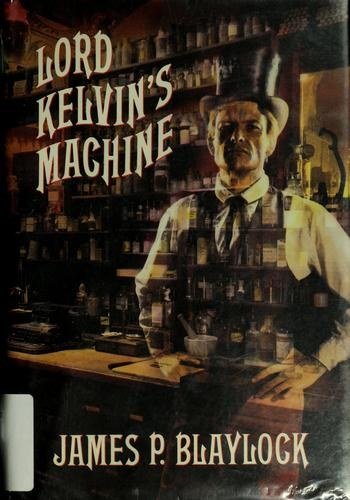
With a title like Lord Kelvin's Machine, one expects either a sober lecture on thermodynamics or a device that should be kept away from curtains, clergy and the structure of reality. James P. Blaylock, sensibly, chooses the latter neighbourhood.
Lord Kelvin's Machine belongs to James P. Blaylock's St. Ives sequence and follows naturally from Homunculus. By 1992, steampunk was becoming easier to recognise as a field rather than a few related outbreaks of inspired eccentricity. Blaylock's contribution remained distinctive: comic, peculiar, learned, and fond of scientific apparatus that seems likely to cause social embarrassment before breakfast.
The novel's title invokes Lord Kelvin, one of the great scientific names of the nineteenth century, and that is part of the fun. Steampunk often borrows real scientific prestige and then sends it down a side corridor where the instruments begin glowing. Blaylock's world thrives in that space between genuine Victorian science, speculative nonsense and narrative delight.
The spreadsheet tags the book with Victorian invention, cosmic peril and eccentric science. Those motifs place it squarely in the field. The machinery is not merely industrial. It has metaphysical reach. The invention threatens or touches larger structures than ordinary engineering should probably be allowed to approach. That is a familiar steampunk pleasure: the apparatus on the bench appears local until one discovers it has opinions about the universe.
St. Ives himself is again central as a type. He is part scientist, part adventurer, part gentleman eccentric, and part excuse for reality to become more complicated. This figure is important to steampunk because he carries curiosity into danger without making curiosity seem dull. He belongs to a family that includes Vernean engineers, gaslamp investigators and later scholar-adventurers with laboratories full of regrettable prototypes.
Compared with The Difference Engine, Blaylock's route into steampunk is more intimate and whimsical. Gibson and Sterling build systems. Blaylock builds peculiar rooms, clubs, contraptions and schemes. Both approaches matter. Without the system-builders, steampunk risks becoming trivial. Without the eccentrics, it risks becoming a census report with pistons.
The St. Ives material also keeps alive the tradition of the gentleman scientist as comic hazard. In Verne, the engineer may be heroic or formidable. In Blaylock, the scientific mind is brilliant but socially odd, prone to becoming entangled in plots that no sensible person would have allowed past the minutes of the previous meeting. This affectionate scepticism is healthy. It lets the genre love science without pretending scientists are immune to folly.
The cosmic peril element widens the scale. Blaylock's eccentric surfaces can make the books feel small and clubby at first glance, but the dangers are often much larger than the social comedy suggests. That contrast is part of the appeal. A conversation in a peculiar room can lead, by regrettable stages, to a threat with astronomical manners.
The book also continues the genre's fascination with scientific names as talismans. Babbage, Kelvin, Lovelace, Tesla and other figures become more than historical persons in retrofuturist fiction. They become doorways into imagined technological branches. That can be lazy if handled as name-dropping, but Blaylock uses the association as part of a broader atmosphere of scholarly mischief.
For readers, Lord Kelvin's Machine works best if approached as a continuation of Blaylock's peculiar steampunk temperament. It is not the place to begin if one wants the single most definitive genre statement. It is, however, essential for seeing how the first-wave eccentric style developed beyond the initial burst.
Is it really steampunk?
Yes. Lord Kelvin's Machine is core steampunk, especially in the Blaylock/St. Ives branch of eccentric Victorian scientific adventure. Its inventions, historical-scientific framing, cosmic stakes and link to Homunculus make it a proper canon entry rather than a mere neighbour.
Its value is partly tonal. The genre needs works that understand the absurdity of invention without sneering at wonder. Blaylock can make machinery funny and still consequential. That is harder than it looks. A device may be ridiculous in outline and catastrophic in effect, which is practically a steampunk design principle.
In the wider guide, this entry should send readers back to Homunculus and sideways to Infernal Devices, The Difference Engine and later St. Ives material such as The Aylesford Skull. It is a reminder that steampunk's canon was not forged only by grim alternate historians. Some of the best work was done by eccentrics with dangerous machines and suspiciously good comic timing.
It is also useful as evidence that steampunk can sustain series continuity without losing its odd edges. The St. Ives books create a recognisable social and scientific world, then keep finding new ways to make that world wobble. For readers who like characterful canon threads rather than isolated premises, Blaylock's sequence is an important route.
The wobble, naturally, is where much of the pleasure lives, along with several worrying scientific implications.
Find it
If you would like to track down Lord Kelvin's Machine, these search links may help. We have not specified an edition, so you can pick the format that suits you.
Affiliate links: as an Amazon Associate, Stephen Hunt’s SFcrowsnest earns from qualifying purchases. These may earn us a small commission at no extra cost to you.