
Why it matters
It is not steampunk, but it is an important early anime example of ruined technology, flying craft, industrial danger and ecological recovery in a form that points towards later Miyazaki machine worlds.
Hayao Miyazaki's Future Boy Conan begins after civilisation has made a heroic mess of things, which is a traditional human pastime, and then finds adventure among islands, ruins and unreliable machines.
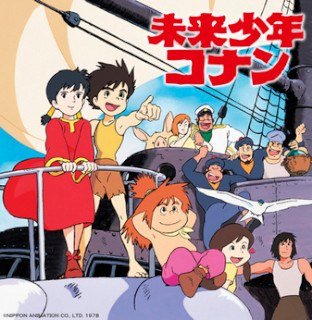
Set in a future after devastating war and environmental collapse, Future Boy Conan follows Conan, Lana and Jimsy through a world of islands, industrial remnants and authoritarian survivors. The series adapts ideas from Alexander Key's The Incredible Tide, but Miyazaki's hand is unmistakable: movement, machinery, weather, child heroes and a deep suspicion that adults with power have usually misread the instructions.
Its connection to steampunk is indirect, yet valuable. The series is post-apocalyptic rather than Victorian. Its technology is not brass fantasy or alternate nineteenth-century engineering. Even so, it uses the remains of industrial civilisation as a dramatic landscape. Lost machines, aircraft, sea travel and damaged infrastructure all matter to the story, and the moral question is never far away: what kind of future can grow from the wreckage?
That question makes it useful beside Nausicaa of the Valley of the Wind and Castle in the Sky. Miyazaki would return again and again to flying machines, ecological fragility, ruined empires and technology that is both wondrous and dangerous. Future Boy Conan is one of the places where that grammar becomes visible on television.
The series also has a cheerful physicality that keeps it from becoming a lecture on apocalypse. Conan runs, climbs, dives and generally treats the world as if it were built by someone who expected children to ignore the safety rail. That bodily adventure gives the damaged future warmth. The machines may be remnants of catastrophe, but the heroes are still alive, curious and annoyingly difficult to kill.
For the wider steampunk map, the importance lies in tone and ancestry. Later retrofuturist animation often combines child adventure with enormous technology, ecological stakes and lost civilisations. Future Boy Conan is not using the same costume rack as classic steampunk, but it is already interested in many of the same dramatic ingredients: machines with history, societies built around power, and invention as both rescue and threat.
It also shows how anime could approach machine fantasy without needing Western Victoriana. The settings are oceanic, ruined and political rather than foggy and urban. The result widens the field. Steampunk-adjacent work does not have to begin at Baker Street or a London boiler room. Sometimes it starts on an island with a boy, a girl and the long shadow of a failed technological age.
That is why the series remains useful even when the label is only adjacent. It catches a pattern that would become familiar in later anime: old machines, young protagonists, military authority, ecological unease and the possibility that recovery will require more than simply restarting the engines. The adventure looks buoyant, but the wreckage under it has weight.
Is it really steampunk?
No. Future Boy Conan is post-apocalyptic adventure anime with proto-steam and retro-machine adjacency. It belongs near steampunk because of its lost technology, flying craft, industrial ruins and ecological machine politics, not because it offers a steam-age alternate history.
Readers interested in Miyazaki's later machine worlds should treat it as an important early signal. The boilers are not quite hissing yet, but the concern with machines, children and ruined futures is already doing strenuous work.
Find it
If you would like to track down Future Boy Conan, these search links may help. We have not specified an edition, so you can pick the format that suits you.
Affiliate links: as an Amazon Associate, Stephen Hunt’s SFcrowsnest earns from qualifying purchases. These may earn us a small commission at no extra cost to you.