
Why it matters
It supplies one of the genre's oldest arguments: what happens when clever people build first and think later.
Before brass goggles, parlour laboratories and steam-driven thunderboxes, there was a student with too much ambition and not enough adult supervision, stitching a new human being out of the available parts bin.
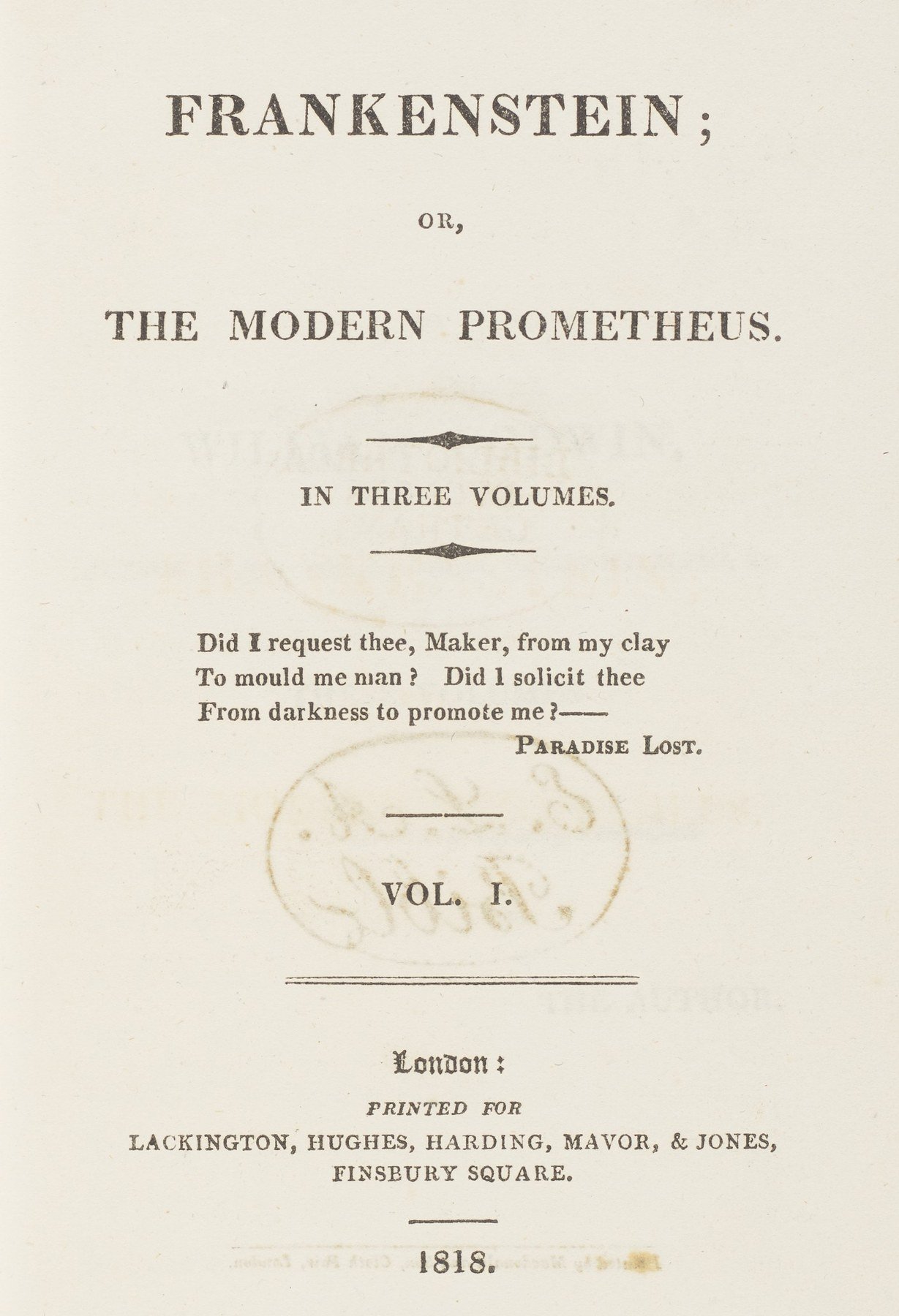
Mary Shelley's Frankenstein; or, The Modern Prometheus is not steampunk in the modern sense. There are no swaggering airship crews, no gentleman inventors with patent-leather boots, and no Queen Victoria peering suspiciously at a brass automaton. What it does have is stranger and more durable: science as a moral hazard, a creator fleeing his creation, and a modern world beginning to realise that knowledge does not come with a built-in conscience.
That makes it one of the great ancestors of the whole steam-age imaginary. Victor Frankenstein is a laboratory man before the popular image of the laboratory man has fully hardened into cliche. He is not a tinkerer in a cosy workshop but a student of natural philosophy, anatomy and forbidden possibility. His apparatus is famously vague, which is probably wise. The book is less interested in the wiring diagram than in the bill that arrives afterwards.
For steampunk, the important thing is not whether Victor's method involves steam, galvanism, chemistry or hand-waving with a storm cloud. It is the posture: a nineteenth-century imagination standing at the edge of modern science and asking whether progress has a reverse gear. Later steampunk often dresses this question in brass, leather and polished wood. Shelley asks it with ice, blood and a childlike creature abandoned by the only parent he has.
The novel also gives the field one of its central tensions: sympathy for the machine, monster or constructed being. Steampunk is full of artificial people, clockwork servants, engineered soldiers and manufactured minds. Frankenstein insists that the made thing is not merely a gadget. It can suffer. It can read. It can accuse. It can become more morally alert than the respectable humans who would like to classify it as a problem and move briskly on.
Purists may object, and with reason, if someone tries to file Frankenstein under core steampunk. It belongs first to Gothic fiction, Romantic literature and the history of science fiction. Yet the border matters. Without Shelley, later mad-scientist tales lose their founding thunderclap. Without the creature, steampunk's automata and artificial intelligences risk becoming mere stage furniture. The novel reminds the field that invention is never only about invention.
Its influence runs through the laboratory wing of steampunk and gaslamp fantasy: the sinister medical school, the ethical experiment, the scientist as both visionary and public nuisance. If Verne supplies the competent engineer and Wells supplies the social machine, Shelley gives us the first great case file in experimental regret.
It is also worth noting how little the novel flatters the idea of genius. Victor is clever, yes, but he is not wise, brave or emotionally reliable. This is useful for steampunk because the genre often has to decide what sort of inventor it is dealing with. Some are practical engineers, some are humane reformers, some are frauds with better tailoring, and some are Victors: people who mistake a breakthrough for a moral permission slip.
The creature, meanwhile, helps keep the field honest about constructed life. Later clockwork men, automata, revived bodies and artificial minds can all become convenient symbols, but Shelley insists on subjectivity. The made being is not only evidence of its maker's skill. It is a new person with memory, appetite, loneliness and judgement. That is a much sharper inheritance than the simple mad-scientist silhouette.
This is why the book still belongs on a steampunk shelf, even if it sits near the edge and glowers at the brass fittings. It supplies the ethical weather. Every laboratory romance, every artificial servant with feelings and every inventor who hides behind "progress" is answering Shelley, whether the answer is brave, foolish or written in sparks.
Is it really steampunk?
No, not if the word is being used narrowly. Frankenstein is best treated as a proto-steampunk and Gothic ancestor: a borderland work that provides the moral machinery later steampunk keeps repainting. It has little interest in retrofuturist spectacle, but it is fascinated by the nineteenth-century bargain between science, pride and disaster.
Readers coming to it from steampunk may be surprised by how little it behaves like a monster romp. Much of the book is confession, pursuit, wounded eloquence and family ruin. The creature is not a lumbering prop but a reader, speaker and philosopher who has every reason to be furious. Victor, meanwhile, is the sort of man who would probably write "visionary" on his calling card while leaving a trail of avoidable misery down the corridor.
Frankenstein is less a matter of brass than of responsibility. Every later inventor who says, "What could possibly go wrong?" should be handed a copy before being allowed near the lightning rods.
Find it
If you would like to track down Frankenstein, these search links may help. We have not specified an edition, so you can pick the format that suits you.
Affiliate links: as an Amazon Associate, Stephen Hunt’s SFcrowsnest earns from qualifying purchases. These may earn us a small commission at no extra cost to you.