
Why it matters
It extends the Nemo myth into undersea-city territory, giving proto-steampunk another branch of aquatic retro-technology.
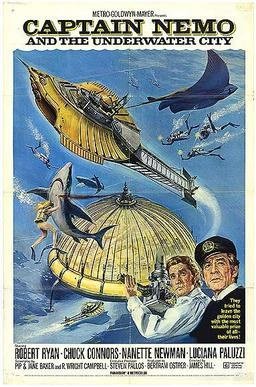
Captain Nemo and the Underwater City asks what Captain Nemo might do after the Nautilus, and answers: real estate, but make it submarine.
Directed by James Hill, this British film is not a straight Jules Verne adaptation so much as a Nemo continuation. Survivors from a sinking ship are taken to an underwater city, where Nemo presides over a society hidden beneath the sea. The premise is pure late-Vernean afterlife: take one legendary inventor, add domes and strange machinery, then see whether civilisation improves when removed from dry land.
For steampunk purposes, the film's attraction is obvious. Underwater cities are one of the great speculative promises of the nineteenth and twentieth centuries, especially when reached through brass-shadow technology rather than sleek modern futurism. The sea becomes the new frontier, and Nemo becomes both host and warning sign.
Nemo himself is the key connection. In 20,000 Leagues Under the Sea, he is the wounded genius using technology to escape and defy the surface world. In Captain Nemo and the Underwater City, that impulse becomes social architecture. Withdrawal has turned into settlement. The result is intriguing because it asks whether Nemo's private rebellion could ever become a workable community.
The film is not as visually definitive as Disney's 1954 20,000 Leagues. It does not own the submarine imagination in the same way. But it does contribute to the undersea branch of retrofuturism: domed habitats, special materials, submarine travel, pressure, secrecy and the fantasy of starting again somewhere the taxman would have trouble finding you.
There is a utopian flavour here, though Nemo's utopias always arrive with fine print. Hidden cities in adventure fiction tend to be both refuge and trap. The deeper one goes, the more likely it is that the plumbing, politics or moral philosophy will turn against the guests.
The film also belongs to a period when Vernean material was being reused as a general adventure vocabulary. Nemo, like Sherlock Holmes or Dracula, had become larger than his original book. He could be moved into new plots because the audience understood the shorthand: mystery, genius, exile, danger and technology with a personal grievance. That shorthand is exactly why steampunk keeps returning to him.
Its steampunk fit is therefore borderland but useful. The film predates the genre label, yet it handles one of steampunk's durable questions: what happens when a brilliant outsider builds an alternative society around superior machinery? Sometimes the result is liberation. Sometimes it is a damp committee meeting with pressure hazards.
The film also sits naturally near The Mysterious Island, another Nemo-haunted adventure in which technology, isolation and survival meet. Nemo is one of the field's great ancestors because he brings the romance of invention and the danger of private power in the same elegant vessel.
Is it really steampunk?
It is proto-steampunk and Vernean adventure rather than modern steampunk. Its undersea setting, Nemo connection, hidden technological society and retro machinery make it important for the aquatic side of the field.
Viewers should treat it as a deep cut, not the canonical Nemo screen text. The point is less perfection than atmosphere: domes under pressure, Nemo in command and the persistent suspicion that the future is wetter than advertised.
Find it
If you would like to track down Captain Nemo and the Underwater City, these search links may help. We have not specified an edition, so you can pick the format that suits you.
Affiliate links: as an Amazon Associate, Stephen Hunt’s SFcrowsnest earns from qualifying purchases. These may earn us a small commission at no extra cost to you.