Why it matters
It is a notable example of steampunk subculture becoming a tabletop setting, tying music, persona, airship adventure and post-apocalyptic world-building together.
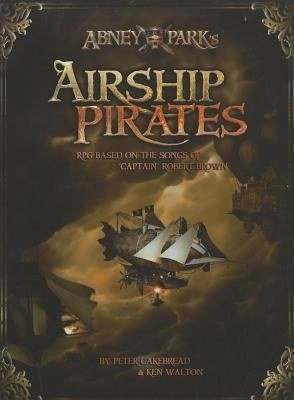
Abney Park's Airship Pirates is the tabletop RPG that looks at a steampunk band and decides the obvious next step is a playable world of time trouble, airships and piracy.
Written by Peter Cakebread and Ken Walton and based on the world of the steampunk band Abney Park, Airship Pirates turns musical identity into roleplaying material. That alone makes it useful. Steampunk is not only a literary and gaming genre; it is also a subculture of bands, costumes, conventions, maker projects and shared theatrical identities.
The premise draws on Abney Park's airship-pirate mythology, with a world shaped by time disruption, post-apocalyptic conditions and rebellious crews. Airships are not decorative here. They are the core fantasy: mobility, outlaw romance, altitude and the chance to leave bad authority below, at least until the plot catches up.
Its importance lies in crossing media. Many RPGs adapt novels, films or original settings. This one adapts a band persona and the wider steampunk music scene. That makes it a record of the genre's cultural breadth in the early 2010s, when steampunk was unusually good at turning aesthetic performance into world-building.
The Cakebread and Walton connection also links it to Clockwork & Chivalry. Both games show an interest in steampunk's cousins and subcultures, though their flavours differ greatly. One goes into English Civil War clockpunk; the other climbs aboard an airship with a bassline and a bad attitude.
For players, the attraction is not sober simulation. It is identity, rebellion, adventure and the joy of a setting that understands airship piracy as both travel plan and lifestyle choice. It is likely at its best when embraced with theatrical confidence rather than treated like a tax document.
Its place in the canon is therefore social as much as textual. Abney Park's Airship Pirates shows steampunk feeding itself across forms: music becomes mythology, mythology becomes game, game becomes another way for fans to inhabit the scene.
That makes it especially useful for understanding steampunk after the genre became a visible subculture. The band did not merely provide a soundtrack to existing fiction. It helped create a persona, a backstory and a participatory mood that could be expanded into play. That is a different path into canon, but it is a real one.
The post-apocalyptic angle also prevents the setting from being only airship swagger. This is not just piracy in goggles. The game imagines a damaged future and lets the pirate fantasy operate as rebellion against an oppressive order. The result is theatrical, but it has a political pulse beneath the costume.
For a table, the promise is immediate: crew, ship, trouble, style. That clarity is valuable. A campaign can begin with a simple question, which is what this crew steals, flees or sabotages next. Many games have taken longer to explain less.
The band connection also gives the game a built-in sense of performance. Steampunk has always been unusually porous between fiction and persona; people do not only read it, they dress it, sing it, build it and take it to conventions. This RPG captures that porousness unusually directly.
It is not the sober historical branch of the field, and it has no reason to pretend otherwise. Its energy is theatrical, rebellious and fan-facing. That makes it a useful marker for the era when steampunk's subculture was not a side effect of the genre, but one of its engines.
Is it really steampunk?
Yes. Abney Park's Airship Pirates is core subculture steampunk, built around airship piracy, post-apocalyptic adventure, band mythology and the performative side of the genre.
It belongs beside the RPG landmarks because it proves the table could absorb not only steampunk fiction, but steampunk fandom's own stagecraft. The airship has a crew, and apparently also a set list.
Find it
If you would like to track down Abney Park's Airship Pirates, these search links may help. We have not specified an edition, so you can pick the format that suits you.
Affiliate links: as an Amazon Associate, Stephen Hunt’s SFcrowsnest earns from qualifying purchases. These may earn us a small commission at no extra cost to you.