
Pillar article
Steampunk vs Gaslamp, Clockpunk and Dieselpunk
Genre labels are useful until they become tiny prisons with brass hinges. Steampunk, gaslamp fantasy, clockpunk and dieselpunk are all attempts to describe stories that look backwards in order to imagine impossible futures. They share old machinery, alternative histories, unusual technologies, period dress, strange cities and a general suspicion that history would have been improved by more dramatic lighting. But they are not the same thing, even if they regularly turn up at the same convention table and borrow one another’s hats.
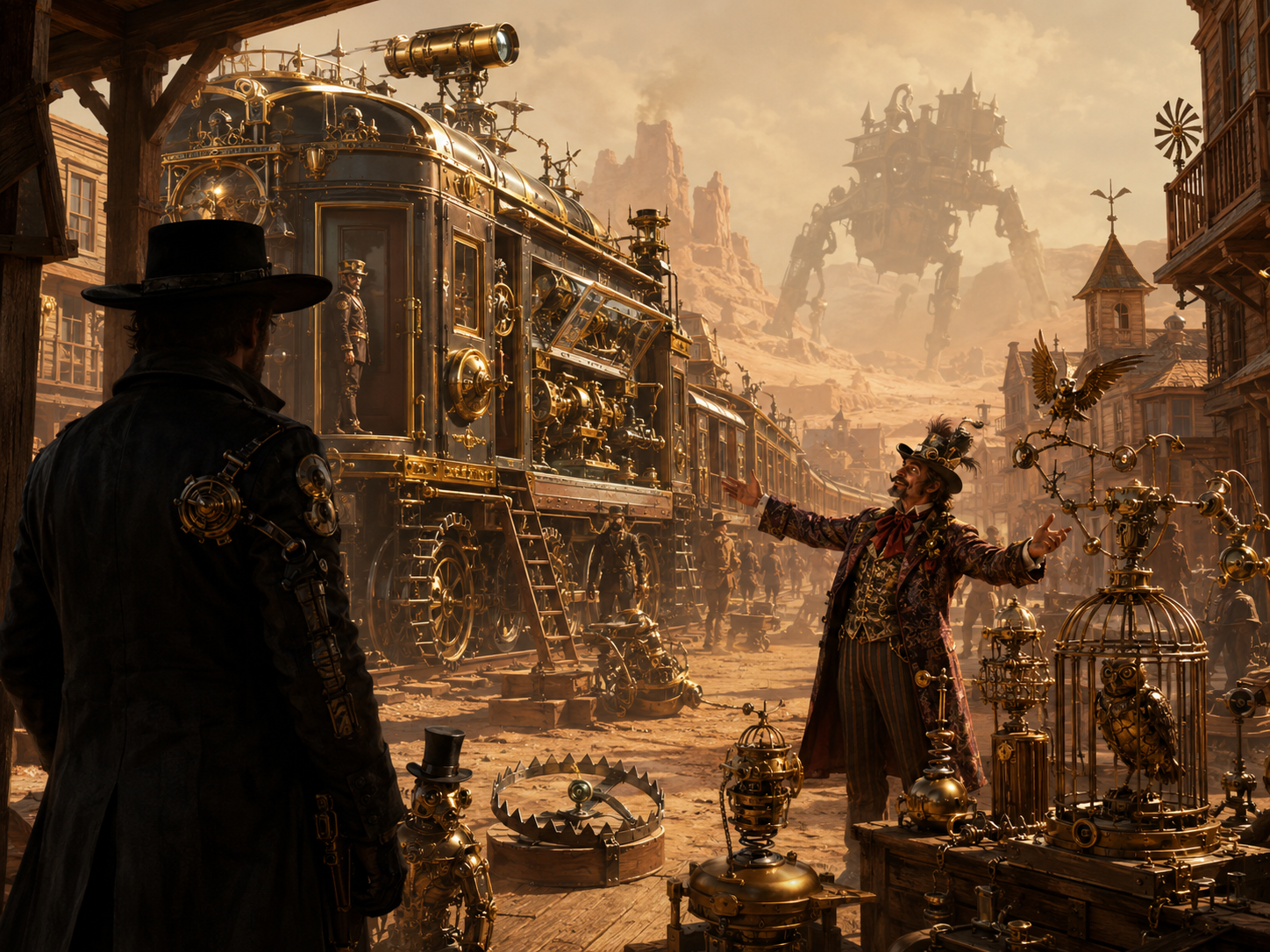
Steampunk is the most famous of the family, largely because it is the one with the best accessories. At its heart, steampunk imagines steam-age technology, usually with nineteenth-century or Victorian inspiration, developing in strange directions. Think airships, steam-powered computers, brass automata, mechanical limbs, pressure gauges, cogs, valves, railways, submarines, impossible engines and gentlemen inventors whose relationship with safety regulations is mainly theoretical.
The “steam” part matters, but not always literally. A steampunk world may run on steam, clockwork, coal, aether, early electricity, alchemy, magic, spirit energy, whale oil or some other invention that would make an engineer twitch. The key is the retro-futurist effect: a past age imagining a future that never happened, or a fantasy world shaped by industrial-age wonder and anxiety. Steampunk asks what might have happened if the nineteenth-century imagination had been allowed to keep inventing without being interrupted by the twentieth century, health and safety, or common sense.
Jules Verne and H.G. Wells are often placed near steampunk’s roots, though they were not steampunk writers in the modern sense. Verne was not writing retro-futurism. He was writing from inside the steam-age imagination itself. Wells was doing scientific romance with a sharper scalpel. They are proto-steampunk, the ancestral boilers. Modern steampunk looks back at their age and rebuilds it with irony, hindsight, critique and better jacket design.
Classic steampunk works tend to involve alternate history, adventure, empire, class, invention, exploration and rebellion. The Difference Engine imagines a Britain transformed by mechanical computers. The Anubis Gates and Infernal Devices belong to the early literary machinery of the genre. Space: 1889 takes Victorian adventure to Mars and Venus, proving that empire becomes no less foolish just because someone has given it an ether flyer. In fantasy, China Miéville’s Perdido Street Station, Philip Reeve’s Mortal Engines and Stephen Hunt’s Jackelian sequence show how steampunk can escape straight historical settings and become secondary-world industrial fantasy, all airships, strange cities, revolutions and machines with too much personality.
Gaslamp fantasy is close to steampunk, but the emphasis shifts. If steampunk is fascinated by technology and invention, gaslamp fantasy is more interested in atmosphere, mystery, magic and the supernatural. It favours foggy streets, séances, vampires, occult societies, haunted houses, secret aristocrats, dangerous rituals, gaslit alleys and detectives who really should have brought a larger pistol. The machinery may still be present, but it is not always the engine of the story. The lamp is more important than the boiler.
Gaslamp fantasy often lives in a Victorian or Edwardian mood, though again it need not be historically exact. Its natural habitat is the drawing room with a hidden door, the cemetery at midnight, the private club with one member too many, the laboratory where the corpse has unhelpfully sat up, and the London street where the fog has become thick enough to start charging rent. It is Gothic, romantic, eerie and often supernatural. Where steampunk asks “what if technology had gone differently?”, gaslamp fantasy often asks “what if the nineteenth century’s ghost stories were right?”
Good examples of gaslamp or gaslamp-adjacent fiction include Anno Dracula, which imagines Dracula victorious in Victorian Britain, and Jonathan Strange & Mr Norrell, which is not steampunk at all but is deeply at home in the historical-fantasy parlour. Philip Pullman’s His Dark Materials has airships, anbaric technology and alternate Oxford, but much of its feel sits closer to gaslamp or parallel-world fantasy than pure steampunk. Gail Carriger’s Soulless cheerfully strolls along the border, parasol in hand, mixing manners, vampires, werewolves and dirigibles into a social comedy with fangs.
The simplest distinction is this: steampunk likes machines; gaslamp likes mysteries. Steampunk gives you the inventor. Gaslamp gives you the medium. Steampunk opens the boiler room. Gaslamp opens the locked room and finds a ghost inside, possibly wearing a cravat.
Clockpunk moves the machinery further back in time. Instead of the steam age, it draws on Renaissance, early modern or pre-industrial mechanical technology: springs, gears, automata, astrolabes, orreries, da Vinci machines, elaborate clocks, mechanical birds, alchemical devices and ingenious murder-boxes built by people with alarming patience. If steampunk is brass and steam, clockpunk is brass and spring tension. It is the age of the artisan-engineer, the philosopher-inventor, the court mechanician and the person who has spent twelve years building a mechanical swan that can deliver poison.
Clockpunk worlds often feel more courtly, alchemical and intricate than steampunk worlds. They are less likely to feature factories and railways, more likely to include guilds, palaces, clock towers, astronomers, mathematicians, secret workshops and mechanical servants with carved faces and suspiciously delicate hands. The danger in clockpunk is not usually mass industrialisation. It is precision. A single device, built by a genius or lunatic, can change a kingdom. Which is inconvenient, as geniuses and lunatics are notoriously hard to label correctly until after the explosion.
Works such as The Alchemy of Stone by Ekaterina Sedia, with its automaton protagonist, sit well in the clockpunk conversation. So do many Renaissance-invention fantasies and clockwork city settings. Some versions of The Three Musketeers with improbable machinery drift in this direction. The category also overlaps with automata stories, alchemical fantasy and alternate Renaissance worlds. Where steampunk thinks in boilers, clockpunk thinks in escapements. Its patron saint is not the railway engineer but the watchmaker with troubling dreams.
Dieselpunk, meanwhile, moves forward. If steampunk belongs broadly to the nineteenth century and clockpunk to earlier mechanical ages, dieselpunk draws on the early to mid-twentieth century: roughly the First World War, the interwar years, the Second World War, pulp adventure, noir, art deco, jazz, aviation, radio, tanks, zeppelins, machine guns, streamlined cities, propaganda posters, gangsters, spies, fascist architecture, trench coats and petrol fumes. Dieselpunk is less brass and more chrome, oil, smoke and steel.
Dieselpunk asks what happens when the romance of machinery meets mass war, modern industry and political extremism. Its machines are faster, louder and more militarised. The airship is still welcome, but now it shares the sky with fighter planes. The inventor’s workshop gives way to the weapons factory. The gentleman adventurer gives way to the pilot, spy, soldier, detective, gangster or resistance fighter. Steampunk may dream of impossible futures from the age of steam. Dieselpunk dreams them from the age of engines, radios and total war, then wakes up sweating.
Examples include Sky Captain and the World of Tomorrow, which is pure pulp diesel spectacle, all giant robots, aircraft and retro-futurist adventure. The Rocketeer is another friendly entry point, full of 1930s glamour, aviation and Nazi unpleasantness. BioShock and BioShock Infinite sit around the dieselpunk and retrofuturist borders, though the latter also borrows sky-city and steampunk-adjacent imagery. Miyazaki’s Porco Rosso is not dieselpunk in the grim sense, but its seaplanes, interwar setting and aviation melancholy make it a beautiful cousin. Dieselpunk likes engines that roar. It also knows the roar may be coming from a bomber.
The difference in mood is important. Steampunk often has wonder at its centre, even when the politics are dark. The machines are strange, ornate and theatrical. Dieselpunk is more anxious, faster and harder-edged. Its technology is closer to our own modern world, which makes its nightmares feel less quaint. A steam-powered battle walker is charming until it shoots at you. A dieselpunk war machine feels as if the twentieth century has already filed the paperwork.
There are other neighbouring terms. “Decopunk” leans into art deco elegance, chrome, skyscrapers, glamour and sleek retrofuturism. “Atompunk” moves into the mid-century nuclear age, with rockets, rayguns, diners, paranoia and the cheerful idea that radiation would probably be fine if packaged correctly. “Raygun Gothic” gives us space-age curves, fins, domes and pulpy interplanetary enthusiasm. “Solarpunk” looks forward with ecological optimism, renewable energy, greenery, community and sustainable technology. Steampunk’s cousins are numerous. Family gatherings require a seating plan.
The confusion often begins because aesthetics overlap. Airships can appear in steampunk, dieselpunk and fantasy. Automata can belong to clockpunk, steampunk or gaslamp. A foggy city might be gaslamp, steampunk, Gothic horror or simply Britain. A story may have Victorian manners, magical technology, vampires, trains, occult science and a detective with a complicated hat. At that point, purity becomes less useful than diagnosis. What is driving the world? What kind of technology or magic shapes it? What period is it echoing? What anxieties is it exploring?
A useful test is to ask four questions.
First, what powers the world? Steam, coal, clockwork, magic, diesel, electricity, alchemy, occult forces, nuclear dreams or something else?
Second, what historical imagination is being remixed? Renaissance courts, Victorian industry, Edwardian adventure, interwar pulp, wartime machinery, Gothic London or a secondary fantasy world with industrial teeth?
Third, what is the central mood? Wonder, mystery, horror, romance, war, noir, satire, adventure, rebellion or survival?
Fourth, what does the story care about most? Invention, empire, class, ghosts, craft, war, crime, faith, ecology, tyranny or the exciting prospect of putting wings on something that clearly should not have wings?
By that test, The Difference Engine is steampunk because its alternate Britain is transformed by mechanical computing and industrial politics. Anno Dracula is gaslamp because its Victorian alternate history is driven by vampires, Gothic society and literary horror. Castle Falkenstein is steampunk and gaslamp fantasy because it has steam-age adventure, faeries, magic and high romance. Fullmetal Alchemist is industrial fantasy or steampunk-adjacent because its world mixes alchemy, militarism, automail and early modern industry. Dishonored is whale-oil punk or dark industrial fantasy, close enough to steampunk to be invited round, but likely to steal the cutlery. Frostpunk is survival steampunk because steam-age machinery becomes the moral centre of society. Arcane is hextech industrial fantasy: not steampunk in the strict sense, but clearly using some of the same gears in a different engine.
This is why arguments about genre purity can become silly. Not because categories are useless, but because stories often succeed by crossing them. The best labels are lanterns, not cages. They help readers find what they want. They help writers understand what promises they are making. They help reviewers explain why a work with airships is not automatically steampunk, and why a work with no airships might still have a deeply steampunk soul.
Steampunk, gaslamp, clockpunk and dieselpunk are best understood as related methods of reimagining history through technology and atmosphere. Steampunk belongs to the steam-age future that never was. Gaslamp belongs to the haunted nineteenth century that might have been. Clockpunk belongs to the age of springs, automata and Renaissance invention. Dieselpunk belongs to the roaring, streamlined, war-shadowed machine age of oil, steel and radio.
Naturally, none of these terms should be used as blunt weapons, unless one is trapped in a panel discussion and the moderator has lost control. A book, film, anime or game may sit between several categories. That is usually a sign of life. Genres grow at the edges, where the map is less tidy and something with too many legs has just wandered out of the fog.
So when someone asks whether a work is steampunk, the best answer may not be yes or no. It may be: what kind of engine is under the bonnet, what century is it arguing with, and how many ghosts are in the boiler room?
If the answer involves brass, empire, invention, fog and an airship making questionable decisions above a clocktower, you are probably somewhere in the right neighbourhood. If the machine starts running on oil, put on a trench coat. If the corpse starts talking, light the gaslamp. If the gears are powered by a spring made by Leonardo da Vinci’s more alarming cousin, welcome to clockpunk.
And if anyone insists there is only one correct label, smile politely, hand them a wrench and ask them to repair the timeline.
Common questions
What is the difference between steampunk and dieselpunk?
Steampunk runs on steam, brass and the nineteenth century; dieselpunk moves forward to the diesel, electric and early-aviation aesthetics of roughly the 1920s to 1950s.
Is gaslamp fantasy the same as steampunk?
Not quite. Gaslamp fantasy keeps the Victorian or Edwardian setting but foregrounds magic and the uncanny over machinery, where steampunk foregrounds invention.
From the cabinet
Related field-guide entries
 Gaslamp / steampunk-adjacent
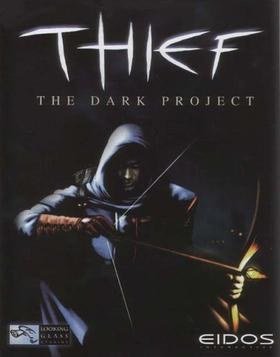
Thief: The Dark Project
Thief: The Dark Project is a gaslamp-adjacent stealth landmark, mixing shadowy city fantasy, religious machinery and proto-steampunk urban mood.
Gaslamp / steampunk-adjacent
Thief: The Dark Project
Thief: The Dark Project is a gaslamp-adjacent stealth landmark, mixing shadowy city fantasy, religious machinery and proto-steampunk urban mood.
 Gaslamp Fantasy / Steampunk-adjacent
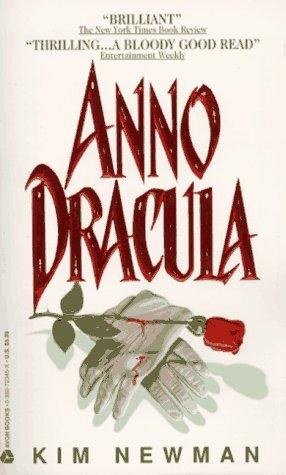
Anno Dracula
Kim Newman's Anno Dracula is gaslamp-adjacent alternate history, turning Victorian vampire fiction into a sharp literary crossover.
Gaslamp Fantasy / Steampunk-adjacent
Anno Dracula
Kim Newman's Anno Dracula is gaslamp-adjacent alternate history, turning Victorian vampire fiction into a sharp literary crossover.
 Post-apocalyptic Steampunk
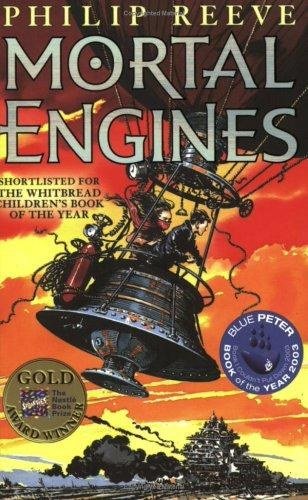
Mortal Engines
Philip Reeve's Mortal Engines is essential YA steampunk, imagining post-apocalyptic traction cities and mobile London.
Post-apocalyptic Steampunk
Mortal Engines
Philip Reeve's Mortal Engines is essential YA steampunk, imagining post-apocalyptic traction cities and mobile London.
 Core Steampunk / Gaslamp Fantasy
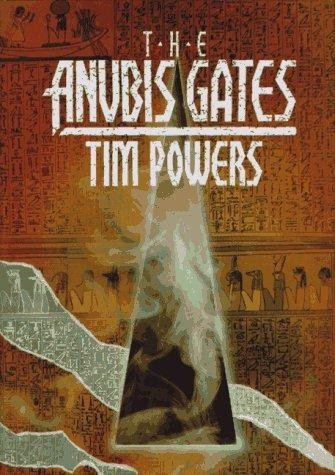
The Anubis Gates
Tim Powers's The Anubis Gates is a first-wave steampunk and gaslamp landmark of time travel, Egyptian magic and London underworlds.
Core Steampunk / Gaslamp Fantasy
The Anubis Gates
Tim Powers's The Anubis Gates is a first-wave steampunk and gaslamp landmark of time travel, Egyptian magic and London underworlds.