
Why it matters
It catches steampunk at the point when the mode had become broad enough to need maps, samplers and argument-friendly collections.
A good steampunk anthology is less a velvet-lined display case than a railway junction at rush hour: engines arriving from several directions, passengers arguing about hats, and at least one contraption making a noise the manufacturer did not promise.
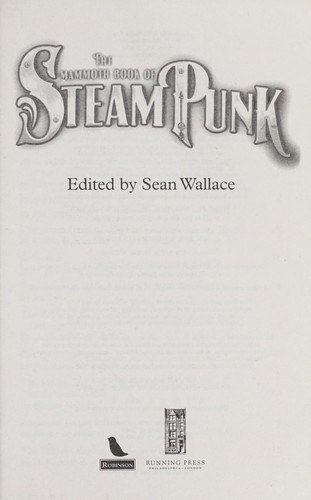
The Mammoth Book of Steampunk, edited by Sean Wallace, belongs to the period when steampunk had escaped the workshop and was busily occupying convention halls, small presses, online magazines, comics, fashion tables and bookshop display stands. Anthologies mattered in that moment because they could show the field as a working spread of possibilities rather than a single brass-plated formula.
The useful thing about a Mammoth volume is scale. It promises quantity, range and a certain sturdy doorstop confidence. For steampunk, that matters because the mode is often misunderstood as a costume rack with a few airships parked nearby. A large anthology can correct that quickly. One story may lean toward adventure, another toward social unease, another toward ornate machinery, another toward strange alternate history. Taken together, the field starts looking less like one boiler and more like a neighbourhood of badly supervised workshops.
Sean Wallace was already an experienced genre editor and anthologist, which gives the book a practical editorial identity. This is not the first steampunk anthology, nor the only one readers need, but it is part of the Maker & Masquerade Age's effort to make the modern field legible. If earlier landmarks proved that steampunk could exist, anthologies like this helped prove that it could multiply.
It also sits usefully beside Extraordinary Engines and Steampunk! because those books perform related but different jobs. Extraordinary Engines helped display British and international literary steampunk at a moment of renewed enthusiasm. Steampunk! was explicitly pitched toward younger readers. The Mammoth Book of Steampunk works more like a broad sampler for readers who want to test the pressure in several pipes before choosing a favourite sub-branch.
Anthologies can be uneven by nature, and that is not automatically a flaw. Unevenness is part of the form's charm and sometimes part of its evidence. A field that has become too tidy is probably dead, or at least waiting for someone to oil it. A mixed collection can show where steampunk stretches, where it repeats itself, and where a writer has decided that the old machine needs either a moral overhaul or a suspicious new lever.
The book's canon value is therefore not that every story must be treated as a separate monument. Its value lies in the anthology function itself. It shows steampunk as a conversation between writers, motifs and reader expectations. Airships, automata, retro-science, imperial shadows, manners, adventure and mechanical spectacle all become ingredients rather than commandments.
Is it really steampunk?
Yes. This is a core steampunk anthology, though the exact flavour naturally varies from story to story. That is precisely the point. Anthologies are where the field admits that no single work can carry the entire contraption on its back without making a terrible clanking sound.
Readers who want one clean novel-length route may prefer The Difference Engine, Boneshaker or The Court of the Air. Readers who want to browse the field, discover authors and watch the subgenre argue with itself should find the anthology useful. It is not a starting pistol so much as a station map.
Find it
If you would like to track down The Mammoth Book of Steampunk, these search links may help. We have not specified an edition, so you can pick the format that suits you.
Affiliate links: as an Amazon Associate, Stephen Hunt’s SFcrowsnest earns from qualifying purchases. These may earn us a small commission at no extra cost to you.