
Why it matters
It shows the field's near cousin, clockpunk, working through Renaissance machines, artistic ambition and political intrigue.
Steampunk likes to pretend the nineteenth century invented all the best trouble, but Pasquale's Angel quietly raises a Renaissance hand and points out that Leonardo da Vinci could have caused plenty of bother without waiting for Queen Victoria to be born.
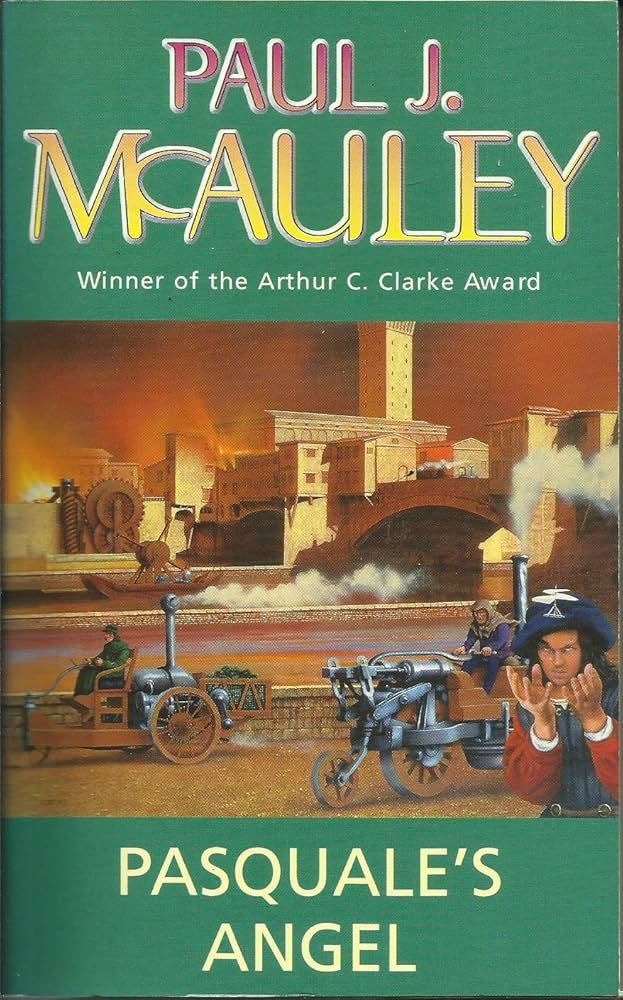
Paul J. McAuley's Pasquale's Angel is one of the useful borderland works because it reminds us that retro-mechanical fantasy does not begin and end with steam. Its alternate Florence is shaped by a Leonardo who has turned away from art and toward engineering, setting loose a different Renaissance of machines, inventions and technical imagination. The result is clockpunk rather than steampunk in the strict sense, but the family resemblance is strong enough to invite dinner.
The novel follows Pasquale, a young artist, through a Florence where mechanical possibility and political danger have grown together. The setting is not a Victorian industrial city, but it shares a great deal with steampunk's favourite historical trick: take a real period of invention and power, alter the technological pressure, then see what happens to ordinary ambition, crime and social order. Renaissance Florence proves just as capable of becoming a speculative machine as London or Paris.
The Leonardo element is central, but the book is not merely a celebrity-inventor cameo. Leonardo functions as a divergence point, a symbol of the Renaissance mind rerouted into practical machinery at scale. Steampunk often does this with Babbage, Lovelace, Tesla or Brunel. Clockpunk does it with Leonardo, automata, gears, springs and mechanical imagination before the steam age takes over the workshop and starts making louder noises.
That makes Pasquale's Angel a good entry for readers trying to understand the difference between clockpunk and steampunk. Clockpunk tends to look earlier, toward Renaissance or early modern mechanisms: clockwork, automata, intricate craft, mathematical devices and hand-built ingenuity. Steampunk tends to look later, toward industrial power, steam, empire, railways and mass machinery. Both share a fascination with technologies that feel visible, tactile and socially disruptive.
The murder and mystery aspects help keep the novel grounded. A purely touristic alternate Florence could easily become a guidebook with gears glued on. McAuley instead gives the machinery consequences inside a plot of investigation and danger. In this sort of fiction, the question is never simply "what can the machine do?" It is also "who wants it, who fears it, and who is already dead because of it?"
Its importance lies in widening the mechanical imagination. A canon that only includes steam risks mistaking one historical costume for the whole retrofuturist family. Pasquale's Angel belongs near the edge of the map, with a neat label saying clockpunk, because it helps explain the neighbouring territory from which steampunk borrows gears, artisanship and the romance of impossible devices.
It also helps clarify why Leonardo remains such a magnet for alternate history. He is already a hinge figure in popular imagination: artist, engineer, anatomist, dreamer, designer of machines that seem to belong half to history and half to a better-funded sketchbook. McAuley's altered Florence takes that familiar potential and asks what happens if the speculative Leonardo is not a solitary genius in the margins, but a force reshaping a city.
That city matters. Florence is not a neutral stage. It brings patronage, politics, art, religion and factional anxiety into the machinery. A steam-age story might ask how factories and empires change society. Pasquale's Angel asks how Renaissance institutions might respond when invention accelerates inside a culture already obsessed with beauty, power and reputation. The result is smaller in scale than an industrial revolution, but no less pointed.
Purists should resist calling it core steampunk. There is no need. It is better as a borderland landmark, showing how the same speculative method works in a different era. Renaissance city-state politics, patronage, art, science and murder give the book a distinct flavour from Victorian gaslight or industrial grime.
Is it really steampunk?
Not quite. Pasquale's Angel is clockpunk and steampunk-adjacent: an alternate Renaissance machine mystery rather than a steam-age retrofuture. It belongs on the map because it shares the genre's concern with altered technological history, visible mechanisms and the social consequences of invention.
The book also offers a useful tonal contrast. Where some steampunk imagines factories, railways and imperial systems, Pasquale's Angel imagines workshops, patronage and Renaissance urban intrigue. The machines feel more artisanal, but not necessarily less dangerous. A gear does not have to be attached to a boiler before it can ruin someone's afternoon.
Readers who enjoy the alternate-history machinery of The Difference Engine may find this an elegant sideways move. Readers who prefer airships and Victorian fog should treat it as a cousin, not a substitute. The pleasure is in watching the field's mechanical obsessions translated into a different historical grammar.
There is also a useful lesson here for writers and readers of steampunk proper. The power of a retro-machine story does not come only from choosing a familiar era. It comes from understanding what that era values, fears and rewards. McAuley's Florence is not Victorian London in fancy sleeves. It is its own social machine, and that is why the clockwork premise has bite.
Find it
If you would like to track down Pasquale's Angel, these search links may help. We have not specified an edition, so you can pick the format that suits you.
Affiliate links: as an Amazon Associate, Stephen Hunt’s SFcrowsnest earns from qualifying purchases. These may earn us a small commission at no extra cost to you.