
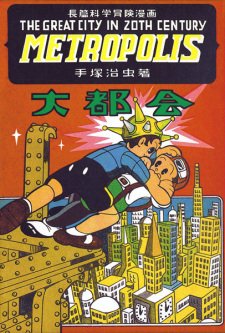
Why it matters
It connects Japanese manga SF to robot anxiety, class-city spectacle and one of the great visual myths of modernity.
Tezuka's Metropolis is what happens when early manga science fiction looks at the modern city, notices the robot, the class system and the enormous symbolic architecture, and decides everyone is probably in trouble.
Osamu Tezuka's Metropolis is the second part of his early science-fiction trilogy, sitting between Lost World and Nextworld. It shares a title and a broad imaginative neighbourhood with Fritz Lang's famous 1927 film, though Tezuka's manga has its own identity and should not be treated as a simple adaptation. The important link is the city as machine, stage and social problem.
For steampunk readers, Metropolis is interesting because it belongs to a parallel ancestry: not steam Victoriana, but retro-scientific modernity. Robots, skyscrapers, class divisions, spectacle and technical ambition all point toward a world where invention has reshaped society faster than wisdom can keep up. That is a very steampunk-adjacent worry, even if the costume department is different.
The robot-girl motif is central. Artificial people are one of speculative fiction's most durable tests of conscience. Tezuka would return again and again to questions of created life, technology and moral responsibility. In Metropolis, those themes are still wrapped in pulp adventure, but the pressure is visible. The manufactured being is not just a clever device; it is a question with eyes.
The city itself matters just as much. Steampunk often loves cities as layered machines: London with secret societies beneath it, New Crobuzon grinding under its own industrial weight, traction cities consuming one another. Tezuka's Metropolis helps place manga in that broader family of urban speculation, where architecture, power and technology are all part of the same argument.
This is also a useful bridge to the 2001 anime film inspired by Tezuka's manga. The later film brings the retrofuturist city imagery into a different visual register, closer to dieselpunk and Art Deco science fiction. The manga remains the earlier source of the idea, a compact post-war Japanese encounter with robots, hierarchy and the dream of the city.
The comparison with Lang's film should be handled with care. Tezuka was influenced by the idea and imagery around Metropolis, but his manga is not just the film redrawn for Japanese readers. It belongs to his own developing set of concerns: artificial life, social order, spectacle, moral confusion and children caught in systems adults have made dangerous.
That gives the manga a place in several histories at once. It is part of Tezuka's early career, part of manga's science-fiction formation, and part of the wider international afterlife of the robot city. Steampunk readers do not need to force it into the boiler room to see why it matters. It is one of the neighbouring electrical substations.
The manga also helps explain why later Japanese retrofuturism could treat artificial people with both spectacle and sentiment. Tezuka's robots are rarely only machinery; they are moral disturbances with faces.
Is it really steampunk?
No, not strictly. Metropolis is proto-manga SF and retrofuturist city fiction, not Victorian steampunk. Its relevance lies in shared motifs: artificial life, class architecture, speculative technology and the city as social machine.
Readers should approach it as historical context rather than as a direct substitute for The Difference Engine or Infernal Devices. It belongs beside Tezuka's other early SF works and near later anime and manga that turn machinery, bodies and cities into moral weather.
Find it
If you would like to track down Metropolis, these search links may help. We have not specified an edition, so you can pick the format that suits you.
Affiliate links: as an Amazon Associate, Stephen Hunt’s SFcrowsnest earns from qualifying purchases. These may earn us a small commission at no extra cost to you.