
Why it matters
It is a major modern tabletop RPG whose haunted city, electroplasmic technology, class pressure and criminal crews give steampunk-adjacent industrial fantasy one of its sharpest playable forms.
Blades in the Dark gives fantasy crime the decency to happen in a soot-black industrial city where even the ghosts appear to have rent arrears.
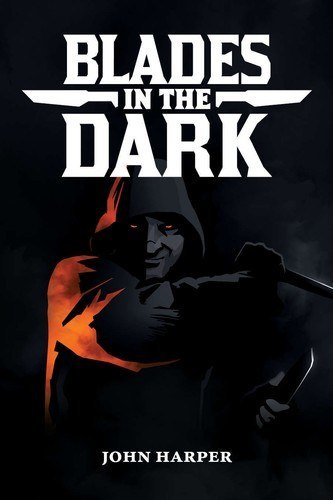
Designed by John Harper, Blades in the Dark is set in Doskvol, a city of gangs, ghosts, lightning barriers, industrial murk and opportunity of the highly illegal sort. Players form a criminal crew and carry out scores while rival factions, supernatural pressures and the city's institutions all close in. It is not a game about noble inventors improving the world. It is about surviving a world that has already been improved in all the wrong directions.
Its relationship to steampunk is indirect but important. Blades in the Dark is not a Victorian alternate-history game, and it does not sell itself on brass decoration. Its engines are industrial fantasy, crime drama and ghost story. Yet its machinery, urban pressure, social hierarchy and haunted technology place it close to the darker industrial wing of the field. Doskvol feels like a city built from coal smoke, bad bargains and civic planning by people who considered sunlight an optional extra.
Electroplasm is the key motif. It powers devices, contains spirits and gives the setting its own weird energy economy. Steampunk often imagines steam as the signature power source, but adjacent works regularly replace it with stranger fuels: aether, ghost rock, magic, phlogiston, electricity or some unwise combination of the above. Blades in the Dark uses electroplasm to fuse industry and haunting. The ghost is not merely in the machine. The ghost may be the machine's operating budget.
The game also matters because its mechanics changed tabletop design culture. Its score structure, flashbacks, faction pressure and crew advancement helped popularise the "Forged in the Dark" family of games. That influence is broader than steampunk, but it matters here because genre worlds live or die at the table by what the rules reward. Blades rewards action, consequence, improvisation and communal criminal ambition. The city becomes not a backdrop but a pressure system.
In canon terms, it sits well beside Perdido Street Station and Unhallowed Metropolis. All three care about cities as bodies: polluted, stratified, hungry and not entirely under their own control. The difference is that Blades asks players to become one more infection in the system, then gives them a crew sheet and tells them to make trouble professionally.
Its class politics are another reason for inclusion. Steampunk can drift into costume pageantry if stripped of labour, poverty and power. Blades in the Dark has no such problem. The city is a hierarchy of bosses, gangs, institutions, workers and desperate climbers. Crime is not a stylish accessory. It is the shape ambition takes when legal doors have locks, guards and a strong preference for people born on the correct side of the street.
That makes it a useful modern landmark for readers tracing how steampunk motifs matured into broader industrial fantasy. It is not interested in Victorian nostalgia. It takes the city, the machine and the social order, then turns the lamps low.
Is it really steampunk?
Adjacent. Blades in the Dark is haunted industrial fantasy rather than core steampunk, but its electroplasmic machinery, class structure, urban industry and Gothic mood make it a close relative.
It suits players who like their industrial fantasy tense, criminal and lit by whatever ghost-powered apparatus has not exploded this week.
Find it
If you would like to track down Blades in the Dark, these search links may help. We have not specified an edition, so you can pick the format that suits you.
Affiliate links: as an Amazon Associate, Stephen Hunt’s SFcrowsnest earns from qualifying purchases. These may earn us a small commission at no extra cost to you.