

Jackelian novel
Jack Cloudie and the Royal Aerostatical Navy
Hornblower with airships, and the cleanest run at the romance of the Royal Aerostatical Navy.
There is an odd, quiet fact about naval fiction that fantasy has never quite come to terms with. The genre — the C.S. Forester tradition, taken up by Patrick O’Brian, sustained by Alexander Kent and Julian Stockwin, and by now the second-longest-running naval reading room in the English language — works because the ship is not a stage set. The ship is a place. It has a mess. It has a watch. It has a bell. It has a captain’s private worry and a topgallant that keeps parting for reasons the sailmaker can and will explain at length. When the enemy hoves into view in Chapter Twenty, the reader is not surprised into caring about the outcome. The reader has been sharing the cabin for two hundred pages, and has opinions.
Fantasy has, on the whole, been polite about all this and then declined the invitation. Naomi Novik’s Temeraire took a serious swing — dragons instead of gun-ships, and admirably done — but the shape of the naval novel proper, transplanted airships-and-all into a fully realised secondary world, has been surprisingly slow to appear on the shelf. Stephen Hunt got there in 2011 with Jack Cloudie, Book Five of the Jackelian sequence, and the result is the cleanest run at the romance of an aerial fleet in modern fantasy. Hornblower with airships, if you like. Or, if you have read a great deal of O’Brian, the young Jack Aubrey at Hunt’s speed and with the artillery replaced by biology.
The book itself
Jack Keats is a Middlesteel rooftop thief whose family has fallen apart. He is caught in the act on a night he should never have been out, and offered the standard nineteenth-century Jackelian choice: transportation to somewhere miserable, or a naval uniform. He picks the uniform. What he does not know is that the Royal Aerostatical Navy has been quietly waiting for a particular kind of small, quick, mechanical-minded lad, and that the tests he passes at the receiving station are not the tests he thinks he is passing. Jack Keats is going to fly.
Half a continent away, a young Cassarabian named Omar bin Barir is walking into his own equally accidental fate. Omar’s is the parallel coming-of-age story: his Caliphate, his desert, his court politics, his religion. Hunt gives the two protagonists roughly equal weight, letting them close on the same war from opposite ends of the map. That war is the one the Caliphate of Cassarabia has been preparing quietly for a very long time. Its sorcerers are the womb-mages, who practise a biological magic in which weapons and servants are grown out of living flesh, and who are exactly as unsettling in the field as that sentence suggests. What the Caliph Eternal’s court believes it is about to do is one thing. What a faction within it is actually about to do is another.
The reader gets both halves. Spoiler-light: it does not go as planned. For either side.
The Royal Aerostatical Navy
This is where Jack Cloudie earns its subtitle. The RAN — a fully realised aerial fleet, lifted by celgas mined out of the Steammen Free State and licensed to Jackals by long treaty — has been a presence in the Jackelian sequence since Book One, but this is the novel that takes you aboard.
Hunt writes the RAN the way O’Brian writes the Royal Navy proper. There are watches, and the watches matter. There is a captain who is not everybody’s friend, and a first officer who is. There is a mess, and the mess has its politics. There is a sail-master, only he is a gas-master, and he can and does explain at length exactly why the current envelope pressure is going to lose Jack a stripe if Jack doesn’t drop what he is doing and attend to it. There is a valve-mind — the thinking-engine that pilots the ship’s larger functions — and Hunt treats it less like magic than like a colleague, which is to say, a colleague who has bad days.
The reader spends a great deal of the novel inside the ship, and this is what a naval novel is supposed to do. Aerial warfare in Jack Cloudie is not a spectacle imported from cinema. It is a job people are doing, at height, in cold, in the wrong shirt for the weather, while somebody biological is being extruded through a Cassarabian gun-port a mile to leeward. When the fleet engagement lands in the second half of the book, it lands because Hunt has spent his set-up currency on the ship rather than on the battle.
Middle-aged first lieutenants and their private difficulties. The way a bosun’s mate acquires tenure. The way a valve-mind’s mood affects the trim. Hunt understands the naval-fiction tradition well enough to know that these are the pleasures the reader has actually turned up for, and he pays them out with a straight face.
Cassarabia, seen properly
Jack Cloudie is also the book in which the Caliphate of Cassarabia stops being a backdrop and becomes a fully realised society. Omar’s viewpoint is the vehicle for this, and Hunt uses it seriously. Cassarabian theology, Cassarabian court politics, Cassarabian scientific-magical practice, and Cassarabian everyday life all get proper hours on the page. Hunt is careful to give the Caliphate its own coherence: not an “eastern” caricature, not a stand-in for anything you are meant to recognise from the news, but a state with its own principles, its own beauties and its own real cruelties, all of them consistent with themselves.
The womb-mages get the same treatment. Their sorcery is horrifying in the specific ways Hunt makes horrifying, but it is not gratuitous. It is doctrinally coherent. It follows from Cassarabian first principles the way steam-power follows from Jackelian ones. That is the harder book to write, and it is the one Hunt writes.
What Hunt does with the form
Hornblower-with-airships would be enough for most novelists and most readers. Hunt is doing rather more than that. The two-protagonist structure — Jack in Jackals’ fleet, Omar in the Caliphate’s court — lets the novel be a war story in which the reader is honestly rooting for people on both sides. That is not a common trick in commercial fantasy; it is closer to the register George MacDonald Fraser sometimes reached in Flashman, or to the way Steven Pressfield writes armies. Jack Cloudie uses it, quietly and without any grandstanding, to make its climate warmer and its stakes real.
The book is also, incidentally, one of the funniest in the sequence. Jack Keats has a Middlesteel rooftop-thief’s ear for language and a fifteen-year-old’s ability to be catastrophically inappropriate in the presence of very serious officers, and Hunt cashes both in throughout. If you have ever laughed aloud at a middie in Forester, you will laugh here.
Where it fits, and who it’s for
Jack Cloudie is Book Five. It does not require the reader to have read the four before it. Cassarabia, the RAN and the wider Jackelian politics are introduced from scratch, and Jack himself is a fresh viewpoint whose Middlesteel is the reader’s Middlesteel, not the returning fan’s Middlesteel. Readers who have read Books One to Four will pick up the additional dividends — a nod at Coppertracks here, a wider shape there — but readers who have not will not feel outside the room.
Choose Jack Cloudie if: you have read a great deal of Hornblower, O’Brian, Kent or Stockwin and wondered what any of them would look like written into a secondary world by someone who has done the reading; you want a war novel whose two sides both make sense; you would like the strangest Jackelian book of the seven, and you would like it delivered by a viewpoint character who is fifteen, mouthy, and unusually good with his hands.
Mind the topgallant. And the gun-port.
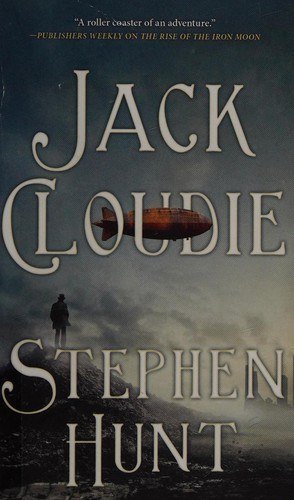 Core Steampunk Fantasy
Jack Cloudie
Stephen Hunt's Jack Cloudie is core Jackelian steampunk fantasy, effectively Hornblower with airships and the Royal Aerostatical Navy.
Core Steampunk Fantasy
Jack Cloudie
Stephen Hunt's Jack Cloudie is core Jackelian steampunk fantasy, effectively Hornblower with airships and the Royal Aerostatical Navy.
Read the full entry
The complete field note, verdict and Amazon links live on the canon entry page.
Open the canon entry