
Why it matters
It is one of the great visual landmarks of screen steampunk, all rust, glass, grotesque machinery and stolen dreams.
The City of Lost Children looks like a Victorian nightmare left in a damp warehouse with too many lenses and a very poor child-care policy.
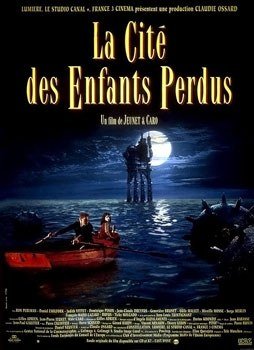
Directed by Marc Caro and Jean-Pierre Jeunet, The City of Lost Children is a French fantasy about a scientist, Krank, who cannot dream and steals children's dreams in an attempt to repair himself. Around that central horror sprawls an industrial waterfront world of orphans, performers, criminals, machines and damp menace.
Its steampunk credentials are mainly visual and atmospheric, but they are powerful. The film's world feels industrial, decayed, handmade and theatrical. Machinery is not sleek or clean. It is grotesque, intimate and faintly diseased, with apparatus that treats optics as a branch of cruelty.
Dream theft gives the film a strong Gothic engine. This is not just a city of machines. It is a city where innocence has become a resource. That idea fits the darker side of steampunk and industrial fantasy, where technology is often tied to class, exploitation and the conversion of human life into fuel, data or spectacle.
The design is central. Lenses, tanks, cables, platforms, diving equipment and shabby interiors create a world that feels both fairy-tale and industrial. Like Brazil, it understands that retrofuturism can be oppressive rather than charming. The machinery has weight, but also moral dampness.
The film is also important because it helped define a late twentieth-century look many viewers now associate with steampunk: greenish light, rusted metal, circus grotesquerie, laboratory glass, absurd institutions and lonely children moving through adult systems that have gone badly wrong. Not all of that is healthy for the genre, but it is undeniably influential.
Its characters add to that texture. One, Miette, the clones, the cultish villains and Krank's strange household all feel shaped by a city where exploitation has become ordinary. The grotesque is not decorative only. It tells us that bodies, labour and dreams have all been dragged into the machinery.
It connects to Jeunet and Caro's earlier Delicatessen, and to adjacent city-nightmare works such as Brazil and Dark City. These are not all steampunk in the same way, but they share a love of constructed worlds where architecture, machinery and social cruelty reinforce one another.
The waterfront setting keeps everything from feeling abstract. Ropes, docks, fog, diving gear and damp rooms give the nightmare a working environment. This is not a palace of evil floating beyond society. It is a place where exploitation feels organised, local and practical, which is far worse.
Purists may ask whether the film has enough alternate history. Perhaps not. Its setting is dreamlike rather than neatly historical. Yet as visual steampunk, it is central: machinery, industrial decay, body oddity, retro technology and social menace are fused so thoroughly that the film practically smells of wet metal.
It is also a useful counterweight to the jaunty airship branch. Steampunk can be joyous, but it can also be claustrophobic, cruel and damp. This film plants its flag in that darker territory and then lights it with a sickly glow. The result is not cosy, but it is unforgettable.
Is it really steampunk?
Yes, as core visual steampunk and industrial fantasy. It is not a tidy Victorian alternate history, but its grotesque machines, dream extraction, retro-industrial cityscape and handmade nightmare logic make it a major field landmark.
It is best for viewers who like the darker, artier end of steampunk, where the machines are marvellous and absolutely not to be trusted with children.
Find it
If you would like to track down The City of Lost Children, these search links may help. We have not specified an edition, so you can pick the format that suits you.
Affiliate links: as an Amazon Associate, Stephen Hunt’s SFcrowsnest earns from qualifying purchases. These may earn us a small commission at no extra cost to you.