Author Profile · Science Fiction
Stephen Baxter
b. 1957 · British
Who is Stephen Baxter?
A Liverpool-born mathematician and engineer (he once applied to be a cosmonaut on Mir; they said no, and the genre profited) who inherited the Stapledon and Clarke tradition and ran with it across geological time. The Xeelee Sequence spans from the Big Bang to the heat death, with humanity as a middleweight species in a war it barely perceives; The Time Ships, his authorised sequel to The Time Machine, won a shelf of awards by taking Wells seriously as physics; Voyage rewrote the space race so NASA went to Mars; Evolution follows the primate line for sixty-five million years. He later collaborated with both Clarke himself and Terry Pratchett (the Long Earth books). Nobody alive handles deep time with a straighter face or a bigger canvas.
Why they matter
The keeper of British SF's cosmological flame: the bridge from Wells, Stapledon and Clarke to the modern field, and the standard for fiction in which the universe's full history is the stage.
Essential books — and where to start
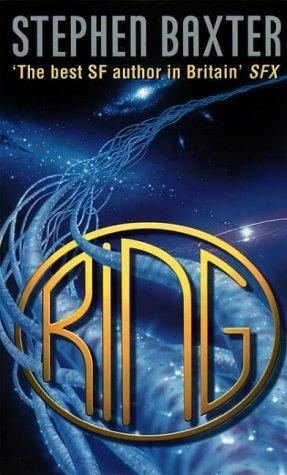
Ring ★ start here
1994 · The Xeelee Sequence · Science Fiction · Hard SF, Space Opera
The Sun is dying millions of years ahead of schedule — infested, it turns out, by photino birds, dark-matter life for whom a stable star is real estate worth renovating. Humanity's answer is the Great Northern, a generation ship looping five million years into the future via relativistic time dilation, carrying the engineer Lieserl (an AI raised inside the Sun itself) toward the Xeelee's parting gift: the Ring, a cosmic-string artefact offering evacuation from a universe the dark-matter ecology has already won. Baxter's physics is genuine, his scale Stapledonian, and his conclusion — baryonic life as a brief, beautiful sideshow — is the genre's grandest consolation prize.
1995 · Science Fiction · Time Travel, Scientific Romance, Hard SF
The authorised centenary sequel to The Time Machine: Wells's Traveller sets out to rescue Weena from the Morlocks and finds the future already different — his own first account, published, has changed history, and observation keeps splitting it further. Baxter sends him through a Dyson-sphere Morlock civilisation (nothing like the brutes of legend), a 1938 London at permanent war, a Palaeocene exile and the deep engineering of the multiverse itself, all in a pitch-perfect Wellsian voice that nonetheless smuggles in quantum mechanics Wells never had. Pastiche raised to the level of collaboration across a century.
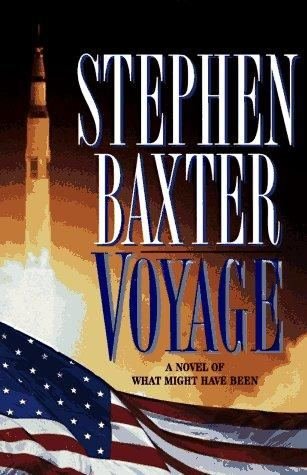
1996 · Science Fiction · Alternate History, Hard SF
Kennedy survives Dallas (wheelchair-bound, a voice rather than a president), and his 1969 phone call to the Apollo 11 astronauts commits America to Mars. Baxter then does something braver than triumphalism: he prices it. The Ares programme cannibalises the shuttle, the probes, the space stations — the entire robotic golden age — and costs lives in a hauntingly plausible pad disaster, before geologist Natalie York, the mission's conscience, finally reads Martian stone with human eyes. Written by an engineer who applied to be a cosmonaut, it is the definitive what-if of the space age: wish granted, invoice attached.
Series
b. 1942 · American
The field's most rigorous builder of alien minds and interstellar economics.
1917–2008 · British
The genre's great optimist-engineer and its finest writer of transcendent endings.
b. 1960 · British
Britain's bestselling space opera writer and the modern master of the multi-thousand-page epic: Night's Dawn and Pandora's Star anchored the form's commercial revival and set the scale modern series compete against.
