From the Earth to the Moon
The founding text of spaceflight fiction, cited as inspiration by rocketry pioneers Tsiolkovsky, Goddard and Oberth.

The essential authors of science fiction, fantasy & horror — and where to start reading them.
Book Entry · Science Fiction
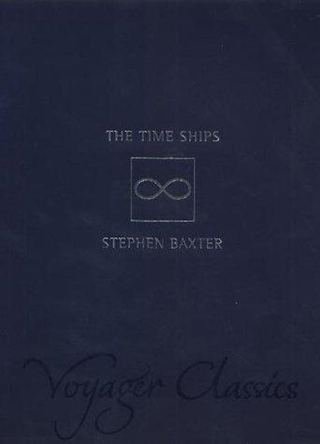
The authorised centenary sequel to The Time Machine: Wells's Traveller sets out to rescue Weena from the Morlocks and finds the future already different — his own first account, published, has changed history, and observation keeps splitting it further. Baxter sends him through a Dyson-sphere Morlock civilisation (nothing like the brutes of legend), a 1938 London at permanent war, a Palaeocene exile and the deep engineering of the multiverse itself, all in a pitch-perfect Wellsian voice that nonetheless smuggles in quantum mechanics Wells never had. Pastiche raised to the level of collaboration across a century.
Winner of the BSFA, Philip K. Dick and Campbell Memorial awards and a Hugo finalist — the rare sequel-by-other-hands regarded as fully worthy of its original.
Prefer Amazon? Buying through these links may earn SFcrowsnest a small commission, at no extra cost to you.
Buy on Amazon UK → Buy on Amazon US →As an Amazon Associate, SFcrowsnest earns from qualifying purchases.
The founding text of spaceflight fiction, cited as inspiration by rocketry pioneers Tsiolkovsky, Goddard and Oberth.
The most ambitious future history ever attempted, directly inspiring Clarke, Lem and Baxter, and establishing deep time as science fiction's playground.
Routinely cited (by Clarke, Lessing and Borges among others) as the most visionary SF novel ever written.