Chasm City
BSFA Award winner; a standalone noir that many readers rate the most purely enjoyable Revelation Space novel, and proof the universe could carry any genre dropped into it.

The essential authors of science fiction, fantasy & horror — and where to start reading them.
Book Entry · Science Fiction
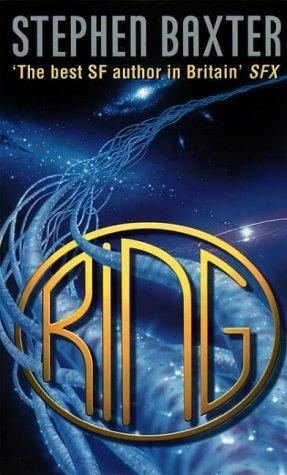
The Sun is dying millions of years ahead of schedule — infested, it turns out, by photino birds, dark-matter life for whom a stable star is real estate worth renovating. Humanity's answer is the Great Northern, a generation ship looping five million years into the future via relativistic time dilation, carrying the engineer Lieserl (an AI raised inside the Sun itself) toward the Xeelee's parting gift: the Ring, a cosmic-string artefact offering evacuation from a universe the dark-matter ecology has already won. Baxter's physics is genuine, his scale Stapledonian, and his conclusion — baryonic life as a brief, beautiful sideshow — is the genre's grandest consolation prize.
The keystone of the Xeelee Sequence and the modern benchmark for cosmological SF: the book that made dark matter a protagonist.
Baxter's future history from Big Bang to heat death: humanity's long, doomed, magnificent war against the godlike Xeelee — who are themselves losing a bigger one.
In the Guide from The Xeelee Sequence:
Prefer Amazon? Buying through these links may earn SFcrowsnest a small commission, at no extra cost to you.
Buy on Amazon UK → Buy on Amazon US →As an Amazon Associate, SFcrowsnest earns from qualifying purchases.
BSFA Award winner; a standalone noir that many readers rate the most purely enjoyable Revelation Space novel, and proof the universe could carry any genre dropped into it.
A masterpiece of far-future SF whose computer-stored citizens anticipate mind-uploading by decades; its mood of luminous melancholy influenced generations of British SF.
Source of the Dark Forest hypothesis, now genuine currency in Fermi-paradox and existential-risk debates — the rare SF concept to cross into scientific discourse with its name attached.