Attack on Titan
Humanity cowers behind giant walls from giant man-eating Titans; starts as straightforward horror and ends as a geopolitical tragedy that ruins dinner parties.
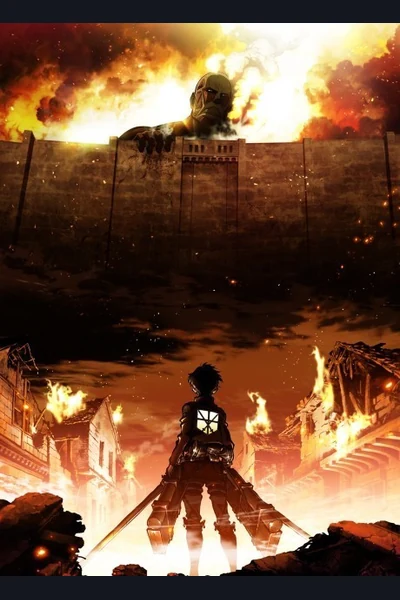
Humanity lives behind three enormous walls while naked giants wander outside eating people. The arrangement has lasted a century, which is long enough for complacency, military ritual and property values near the inner wall to develop. Then a Colossal Titan looks over the defences and reminds everybody that a wall is only reassuring until the thing outside becomes taller.
Hajime Isayama's manga ran in Kodansha's Bessatsu Shonen Magazine from 2009 to 2021 and was collected in 34 volumes. The anime began in 2013 at Wit Studio and concluded under MAPPA in 2023 after several seasons, parts and final chapters whose naming system became a secondary endurance test.
Overview
Eren Yeager survives the destruction of his home and joins the military with Mikasa Ackerman and Armin Arlert. He wants to exterminate the Titans; Mikasa wants to keep Eren alive despite his aggressive objections; Armin wants to see the world beyond the walls. Their training leads into the Survey Corps, whose mission combines reconnaissance, aerial sword fighting and casualty rates that would trouble even the least reflective procurement office.
The early series is survival horror driven by questions. What are Titans? Why do the walls exist? What does the government know? Why is everybody behaving oddly whenever a basement is mentioned? Answers widen rather than simplify the story, shifting it towards history, nationalism, inherited guilt and war.
Why it matters
Attack on Titan became a gateway series because its hook was immediate and its mysteries invited collective speculation. The vertical manoeuvring equipment gave combat a distinctive physical language, while the Titans combined absurd anatomy with genuine terror. Their smiles are particularly objectionable.
Isayama's larger achievement is structural. Early incidents acquire different meanings after later revelations. Enemies become populations, slogans become historical tools and the desire for freedom becomes dangerous when defined as the removal of everybody in the way. The series keeps asking whether victims can resist becoming perpetrators once power changes hands.
Its politics have generated fierce debate, not all of it improved by social media. The work depicts militarism, ethnic persecution and fascist imagery rather than offering a neat programme. Readers can reasonably disagree about whether its final argument controls the forces it unleashes. Neutrality need not mean pretending those arguments do not exist.
What to expect
Expect graphic death, dismemberment, cannibalistic imagery, child soldiers, suicide, torture and mass violence. The horror changes form but does not leave. Comedy is sparse and often arrives through exhausted soldiers attempting to remain human. Romance is restrained; devotion, friendship and ideological fracture matter more.
The manga's early drawing is rough but becomes substantially more controlled. Wit Studio's anime supplies speed, music and operatic force; MAPPA adopts a heavier visual texture suited to the later war material. The studio change is noticeable but the continuity remains coherent.
Adaptations and versions
The completed manga is the simplest chronology and the best way to inspect Isayama's foreshadowing. The anime follows the main story closely while rearranging or compressing some material. Watch numbered seasons in release order, then the concluding specials as labelled by the service carrying them.
OVAs add side stories and character material but are optional. Live-action Japanese films make major changes and should be treated as an alternate version, not a shortcut. Avoid encyclopaedias and thumbnails until finishing; this franchise's spoilers travel without luggage.
Where to start
Anime episode one is a brutally effective entrance. Continue in release order and resist explanations promising to clarify the premise. Confusion is part of the design. Manga readers should begin at volume one even if familiar with the anime, because early visual details reward a second inspection.
Verdict The SFcrowsnest take
Attack on Titan begins as a wall, a monster and a very bad day, then becomes an argument about freedom conducted by traumatised nations with weapons. It is ambitious, frequently brilliant and unwilling to let victory remain morally clean.
The ending will not reconcile every reader, nor should controversy be mistaken for automatic depth. Yet the journey from siege horror to geopolitical tragedy remains one of modern anime's most formidable constructions. Recommended for adults and older teenagers prepared for violence, despair and the discovery that the basement was not, in fact, going to simplify matters.