
Ghost in the Shell
A cyborg cop interrogates what's left of the human soul in a fully networked world; the film that quietly taught Hollywood how the future should look.
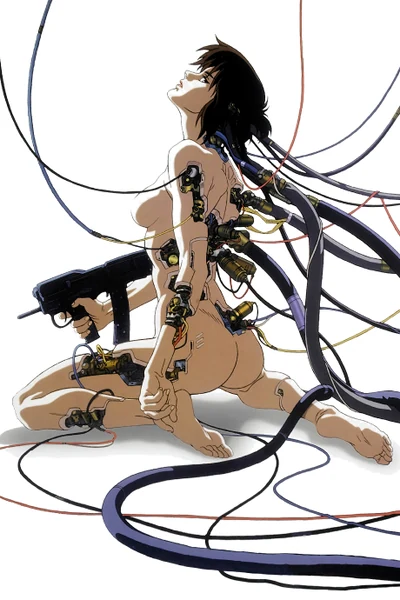
Major Motoko Kusanagi commands Public Security Section 9 in a future where bodies can be replaced, minds connect directly to networks and cybercrime can edit a person's memories before breakfast. The title's “ghost” is consciousness; the shell is the body. The franchise spends several decades asking whether either term remains stable once technology has joined the meeting.
Masamune Shirow's manga began publication in 1989. Mamoru Oshii's 1995 animated film established its most internationally influential form, followed by Innocence. Stand Alone Complex, Arise, SAC_2045 and a Hollywood live-action film occupy related but separate continuities. This is less a single adaptation chain than several philosophical police departments sharing names and equipment.
Overview
Section 9 investigates terrorism, political corruption, cybercrime and threats emerging from networked society. Kusanagi is a full-body cyborg, formidable in combat and uncertain whether continuity of memory is enough to define a self. Her team includes the almost entirely human Togusa, heavily cyberised Batou and chief Daisuke Aramaki, who can defeat ministerial obstruction without removing his coat.
The technology is embedded rather than exhibited. Cyberbrains are tools of work and vulnerabilities to intrusion. Artificial bodies complicate gender, ownership and mortality. The future feels convincing because bureaucracy arrived before the camera and has already written regulations nobody follows.
Why it matters
Oshii's 1995 film became a central cyberpunk text, influencing filmmakers including the Wachowskis and shaping the screen language of networked consciousness. Its city montages, choral score and reflective pace refuse to treat philosophy as an interval between gunfights.
Shirow's manga is busier, more comic and more technically annotated. Kusanagi is lighter in temperament; politics and hardware occupy dense pages. Stand Alone Complex builds a third balance, combining procedural cases, team dynamics and season-long conspiracies. None is simply the same story in another coat.
The franchise's questions have aged into ordinary anxiety. If memories can be altered, what authenticates identity? If a corporation supplies the body, who owns continued life? If an intelligence emerges from the network, does its lack of childhood make it property? These matters now arrive wearing product-launch lanyards.
What to expect
Expect adult science fiction, nudity associated with artificial bodies, gun violence, political complexity and sustained discussion. The films are meditative; Stand Alone Complex is more accessible but still expects attention. Comedy exists mainly in the manga and Tachikoma robots, who approach consciousness with disarming cheer.
The 2017 live-action film's casting of Scarlett Johansson generated justified controversy around whitewashing, compounded by a story attempting to make that casting part of its identity plot. It offers impressive production design but is not the recommended entrance.
Adaptations and versions
For film continuity, watch Ghost in the Shell (1995) then Ghost in the Shell 2: Innocence. The later Ghost in the Shell 2.0 revises the first film with altered effects and is an alternative edition, not a sequel.
For television, start with Stand Alone Complex, continue to 2nd GIG and Solid State Society, then approach SAC_2045 as its later continuation. Arise is a separate prequel/reimagining with its own versions and compilation. The manga can be read independently at any point.
Where to start
Choose the 1995 film for concentrated philosophical cinema or Stand Alone Complex for character, cases and a broader political world. Do both eventually. Avoid trying to combine every continuity into one timeline; the resulting diagram will become self-aware and request asylum.
Verdict The SFcrowsnest take
Ghost in the Shell is foundational cyberpunk because it treats technology as a condition of being rather than a collection of shiny props. Its best versions combine tactical competence with uncertainty about who, exactly, is doing the thinking.
The 1995 film is essential; Stand Alone Complex is the most welcoming long form; Shirow's manga supplies the unruly source. Enter anywhere sensible and keep your passwords private. The future is already asking whether you are the authorised user of yourself.