
Tokyo Ghoul
A shy student becomes a half-flesh-eating-ghoul and has a thoroughly miserable time; the connoisseur's edgelord favourite, complete with that centipede noise.
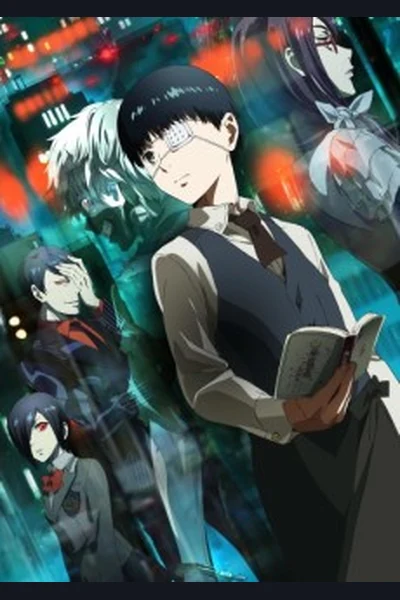
Ken Kaneki is a shy literature student whose promising date ends with the woman attempting to eat him. An accident leaves her dead and Kaneki critically injured; a surgeon transplants her organs into him, producing a human-ghoul hybrid who can no longer stomach ordinary food. Dating was already difficult without discovering that the dessert menu now contains the waiter.
Sui Ishida's Tokyo Ghoul manga ran from 2011 to 2014, followed by the sequel Tokyo Ghoul:re from 2014 to 2018. Studio Pierrot's anime began in 2014 and became famous both for its music and for adapting a complicated story with the confidence of somebody packing a library into hand luggage.
Overview
Ghouls resemble humans but survive by eating human flesh. They possess predatory organs called kagune and live concealed within Tokyo, some hunting and others building fragile arrangements that reduce harm. Kaneki is taken in by Anteiku, a café whose ghoul staff teach him how to exist between appetites and identities.
The investigators of the Commission of Counter Ghoul hunt them using weapons made from ghoul organs. Neither side remains morally uniform. Families, predators, bureaucrats and idealists exist across the divide, while Kaneki becomes a contested body upon which each group writes its theory of coexistence.
Why it matters
Ishida uses horror to examine identity, trauma and the violence of enforced categories. Kaneki wants to remain human because humanity represents safety and morality; his body refuses the distinction. Hunger becomes shame, power and evidence that respectability cannot protect him from what others see.
The manga's art evolves dramatically, from nervous shadows into dense, expressionistic pages where identity can fracture across layout and line. Literary references are not decorative. Books become a means by which characters recognise one another and by which Ishida discusses masks, authorship and selves assembled under pressure.
Its reputation for adolescent darkness is earned but incomplete. There is torture, black clothing and a famous change of hair colour. There is also careful attention to found family, disability, bureaucracy and the way damaged people reproduce the systems that damaged them.
What to expect
Expect cannibalism, graphic injury, torture, suicide themes, psychological breakdown and substantial body horror. Comedy and tenderness exist but do not make this casual family viewing. Romance matters, though intimacy is inseparable from identity and danger.
The story uses a large cast, shifting names and altered appearances. Attention is required even in the manga. The anime's compression makes this considerably harder, particularly once it begins omitting connective tissue and expecting viewers to walk across the gap.
Adaptations and versions
The manga is strongly recommended. Read Tokyo Ghoul in full, then Tokyo Ghoul:re. This preserves Ishida's character development and political structure.
The anime's first series adapts the opening with notable atmosphere and a celebrated theme song. Tokyo Ghoul √A follows an anime-original route that diverges from the manga. Tokyo Ghoul:re then attempts to return to manga material while compressing a great deal, producing confusion for viewers who have not read what the previous series declined to adapt. It is a fascinating case study in adaptation planning and a less reliable narrative map.
Where to start
Start with manga volume one. The anime can be sampled afterwards for performance, music and selected scenes, but should not be the sole version if understanding the story matters. Anybody already lost after √A has not failed a test; the test was missing several pages.
Verdict The SFcrowsnest take
Tokyo Ghoul is a serious horror manga wearing the wardrobe of an edgelord favourite. Its violence is extreme, but the central concern is humane: what becomes of a person forced into a category both sides define as monstrous?
Ishida's manga is ambitious, beautiful and occasionally overburdened. The anime offers powerful fragments without a dependable whole. Read the books, then visit the adaptation for its voices and music. Kaneki has already lost enough of himself without the audience losing half the plot as well.