
Vinland Saga
A Viking revenge saga that yanks the handbrake and skids into a meditation on pacifism; 'I have no enemies' will quietly take you apart.
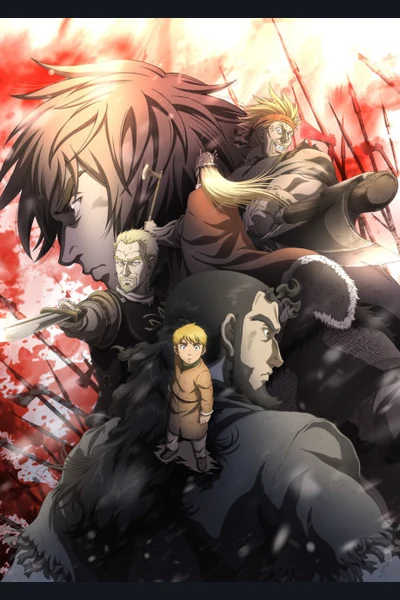
Young Thorfinn grows up on stories of Vinland, a fertile land beyond the sea where war and slavery might be left behind. Then violence enters his home and he devotes himself to revenge, joining the mercenary band of the very man he wants to kill. This is a poor foundation for childhood development but a historically plausible route into Viking employment.
Makoto Yukimura's manga began in 2005, moving from Weekly Shonen Magazine to Kodansha's Monthly Afternoon as its scope and audience matured. Wit Studio produced the first anime series in 2019; MAPPA continued with the second in 2023 while retaining much of the creative team. The apparent studio handover is less disruptive than the story's own decision to change what kind of saga it intends to be.
Overview
The opening follows Thorfinn through Danish campaigns in early eleventh-century England. His commander and target, Askeladd, is a manipulator, strategist and magnificent scoundrel whose shifting loyalties keep the war material alive. Prince Canute begins as a sheltered royal and develops under pressures that would make an ordinary leadership seminar seem underfunded.
Combat is brutal and occasionally heightened beyond realism, but Yukimura grounds the story in political history, labour and material need. Warriors need food, rulers need legitimacy and villages absorb the cost of other men's glory. The series is interested in the people outside heroic songs, usually because the heroic songs have just burned their house.
Why it matters
The decisive turn comes when Vinland Saga interrogates its own revenge narrative. Violence has made Thorfinn formidable and almost empty. The story asks what strength means once killing is no longer accepted as proof of manhood. Its answer—summarised by the phrase “I have no enemies”—is not passive innocence but a discipline learned after terrible participation.
This makes the quieter farming and slavery material essential, not a delay before the action resumes. Work, friendship and responsibility rebuild a person whom combat reduced to a weapon. Yukimura refuses the convenient fantasy that renouncing violence erases its consequences. Pacifism must operate among armed people, unjust systems and memories that do not consent to disappear.
What to expect
Expect graphic battle violence, enslavement, abuse, death and the social machinery of war. The first major phase is a revenge epic; the next is slower, introspective and deliberately repetitive in its daily labour. Viewers seeking continuous Viking raids may feel the handbrake. That skid is the point.
Comedy and warmth increase as Thorfinn learns to live among others. Romance is restrained. Historical figures and events are adapted freely around fictional characters, so this is informed drama rather than a documentary with unusually good hair.
Adaptations and versions
The manga is the continuing source and offers Yukimura's increasingly detailed art. The anime follows closely, with Wit handling the war prologue and MAPPA the farm arc. Visual continuity remains strong; the second series appropriately gives faces, fields and silence as much care as combat.
Begin with season one, then season two. Do not skip the first because the second contains the famous moral thesis, or skip the second because the first has more axes. Each is the argument the other requires.
Where to start
Anime episode one or manga volume one both work. The anime's music and landscape make an immediate impression; the manga gives finer control over pace. Allow the story to change genre when it needs to. Thorfinn cannot become another person while the series remains exactly the same programme.
Verdict The SFcrowsnest take
Vinland Saga begins by making revenge exciting, then holds the excitement accountable. It is a rare historical action series willing to ask whether the admired warrior is merely the person most thoroughly damaged by his society.
Violent, thoughtful and profoundly humane, it earns its hope through labour rather than speeches. Recommended for viewers prepared to follow a boy from vengeance towards the much harder ambition of causing no further harm. There are no easy enemies, and no easy peace.