Carrie
The debut that launched horror's biggest career and, via De Palma's 1976 film, a permanent cultural archetype: the bullied girl as apocalypse.

The essential authors of science fiction, fantasy & horror — and where to start reading them.
Book Entry · Horror
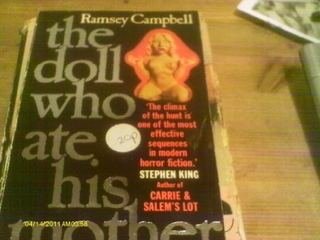
A car crash on a Liverpool flyover: Clare Frayn's brother is killed, and his severed arm is taken from the scene — eaten, the evidence eventually suggests — by a young man named Chris Kelly, raised under the influence of a dead occultist who promised his followers a child shaped into something new. Clare's amateur investigation, in company with a true-crime writer whose interest is not as clean as hers, descends through Liverpool's bombed-out churches and condemned terraces toward a cellar the book has been quietly building the whole time. Campbell's first fully realised novel: urban dereliction as occult geography.
The book where British horror's modern voice — municipal, paranoid, precisely seedy — first sounded at novel length; the foundation of Campbell's six-decade dominance of the field's literary wing.
Prefer Amazon? Buying through these links may earn SFcrowsnest a small commission, at no extra cost to you.
Buy on Amazon UK → Buy on Amazon US →As an Amazon Associate, SFcrowsnest earns from qualifying purchases.
The debut that launched horror's biggest career and, via De Palma's 1976 film, a permanent cultural archetype: the bullied girl as apocalypse.
The foundational modern-witchcraft novel, filmed three times (best as Night of the Eagle / Burn, Witch, Burn) and the clear ancestor of suburban-occult fiction from Ira Levin onward.
The book that, with King's early run, defined the late-70s horror boom's upper register — King has called it one of the finest horror novels of the century — and the modern model for the guilt-returns ghost narrative; filmed, reductively, in 1981.