The Three-Body Problem
Hugo winner 2015 — the first novel in translation and the first by an Asian writer to take the award — opening Anglophone SF to Chinese science fiction at a stroke; adapted by Netflix and, at length, Tencent.

The essential authors of science fiction, fantasy & horror — and where to start reading them.
Book Entry · Science Fiction
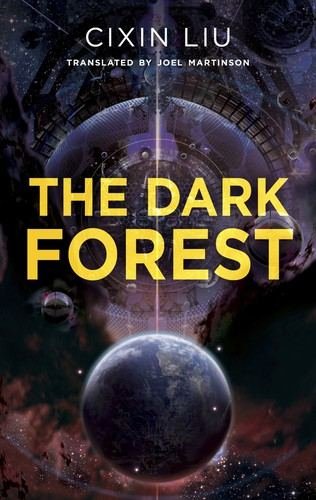
by Liu Cixin · 2008 · Remembrance of Earth's Past, book 2
With sophons reading every document and conversation on Earth — but not minds — humanity's defence rests on the Wallfacers, four individuals empowered to act without ever explaining themselves. Three produce monstrous failures; the fourth is Luo Ji, a cynical nobody whose only qualification is that the enemy once tried to kill him. His decades-spanning gambit, via hibernation, a fairy-tale romance conjured to order and one broadcast spell cast at a star, culminates in the trilogy's central revelation: the universe is a dark forest, every civilisation a hunter, and survival belongs to the silent. The Battle of Darkness and the droplet attack supply the nightmares.
Source of the Dark Forest hypothesis, now genuine currency in Fermi-paradox and existential-risk debates — the rare SF concept to cross into scientific discourse with its name attached.
The Three-Body trilogy: from a Cultural Revolution radio signal to the end of the universe, via the Dark Forest — first contact as cosmic game theory.
In the Guide from Remembrance of Earth's Past:
Prefer Amazon? Buying through these links may earn SFcrowsnest a small commission, at no extra cost to you.
Buy on Amazon UK → Buy on Amazon US →As an Amazon Associate, SFcrowsnest earns from qualifying purchases.
Hugo winner 2015 — the first novel in translation and the first by an Asian writer to take the award — opening Anglophone SF to Chinese science fiction at a stroke; adapted by Netflix and, at length, Tencent.
With Judas Unchained, Hamilton's most acclaimed work: the Primes are a first-contact nightmare ranked with the Moties, and the Commonwealth became the template for post-scarcity-with-trains worldbuilding.
Hugo, Nebula and Locus winner; the genre's definitive megastructure, inspiring physics papers, the Halo franchise and fifty years of Big Dumb Object fiction.