Revelation Space
BSFA-shortlisted debut that established hard space opera's gothic wing; the Dark-Forest-adjacent Inhibitor solution to the Fermi paradox predates Liu's and haunts the whole subgenre.

The essential authors of science fiction, fantasy & horror — and where to start reading them.
Book Entry · Science Fiction
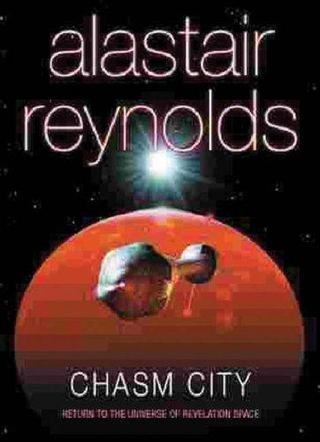
Tanner Mirabel, security operative from war-ruined Sky's Edge, follows the man who killed his employer to Yellowstone — arriving to find the legendary high-tech utopia seven years after the Melding Plague turned its nanotech baroque: the Glitter Band reduced to the Rust Belt, Chasm City's buildings grown into diseased gothic forms, immortals playing kill-games out of boredom. Threaded through the hunt are indoctrinal-virus visions of Sky Haussmann, the generation-fleet hero-criminal whose crucified legend won't stay separate from Tanner's own memories — for reasons that constitute one of the genre's best long-fuse reveals.
BSFA Award winner; a standalone noir that many readers rate the most purely enjoyable Revelation Space novel, and proof the universe could carry any genre dropped into it.
Reynolds's gothic hard-SF universe: lighthugger ships, plague-warped architecture, and the Inhibitors — machinery left on watch to suppress spacefaring life, for reasons that turn out to be uncomfortably good.
In the Guide from Revelation Space:
Prefer Amazon? Buying through these links may earn SFcrowsnest a small commission, at no extra cost to you.
Buy on Amazon UK → Buy on Amazon US →As an Amazon Associate, SFcrowsnest earns from qualifying purchases.
BSFA-shortlisted debut that established hard space opera's gothic wing; the Dark-Forest-adjacent Inhibitor solution to the Fermi paradox predates Liu's and haunts the whole subgenre.
A masterpiece of far-future SF whose computer-stored citizens anticipate mind-uploading by decades; its mood of luminous melancholy influenced generations of British SF.
Source of the Dark Forest hypothesis, now genuine currency in Fermi-paradox and existential-risk debates — the rare SF concept to cross into scientific discourse with its name attached.