Pokemon
A boy leaves home to befriend, then imprison in small balls, the local wildlife; against all odds the most wholesome and most lucrative franchise on the planet.
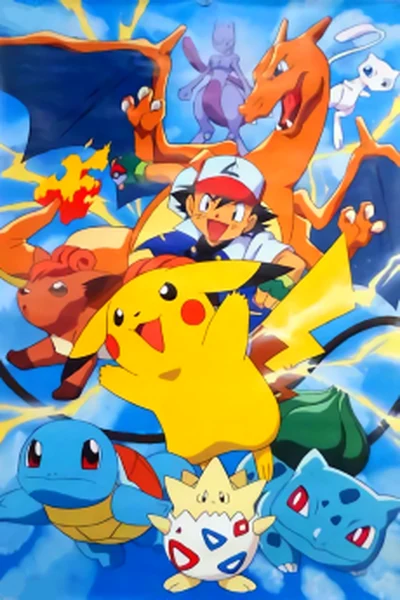
Pokémon imagines a world where children travel without visible income, collect creatures with elemental powers and compete in regulated battles while adults respond with cheerful institutional support. The arrangement raises questions, but it has also produced Pikachu, and Pikachu has negotiated from a position of considerable strength.
The franchise began with Game Freak's Japanese Game Boy titles in 1996, created under the direction of Satoshi Tajiri and published by Nintendo. The television anime followed in 1997, turning Ash Ketchum and his reluctant Pikachu into global fixtures. Manga, trading cards, films, toys and several economic weather systems followed.
Overview
Humans live alongside Pokémon as companions, workers, research subjects and competitive partners. Trainers catch them in Poké Balls, build teams and challenge regional Gyms. Each game generation introduces a new region, species and variation on the journey towards championship.
The original anime follows Ash from Pallet Town through numerous regions with Pikachu, changing companions and a Team Rocket trio whose commitment to unsuccessful entrepreneurship deserves a pension. After Ash's long story reached a conclusion, Pokémon Horizons introduced new protagonists Liko and Roy and a more serialised mystery.
Why it matters
Pokémon translated collecting, trading and competition into social play. The original games required another person to complete the creature catalogue, making cooperation and mild playground extortion part of the design. The anime gave each species personality and made a yellow electric mouse more recognisable than several heads of state.
Its world is flexible enough to support sport, ecology, detective stories and friendship. It also avoids inspecting its own animal ethics too closely. Pokémon are generally depicted as willing partners, villains are condemned for exploitation and the balls remain conveniently comfortable. The franchise knows where the trapdoor is and keeps a rug over it.
What to expect
The main anime is family entertainment with comic peril, battles and occasional episodes capable of causing adults unexpected emotional damage. Creatures faint rather than die in ordinary competition. Films can introduce heavier themes but remain broadly accessible.
Repetition is fundamental: new town, new creature, Team Rocket, lesson, onward. Children often find ritual reassuring. Adults may discover the theme song has occupied permanent neural property.
Adaptations and versions
There is no single Pokémon manga continuity. Pokémon Adventures offers a more serialised adaptation of game worlds; other manga target different audiences and tones. The films attach mainly to the anime era in which they appeared but are usually optional.
The games remain the source engine. Anime, cards and manga reinterpret rather than simply adapt them. Detective Pikachu games and the live-action film form another branch, distinguished by the discovery that Pikachu can sound like Ryan Reynolds without civilisation ending.
Where to start
Children can begin with the current accessible game or Pokémon Horizons. Viewers wanting the historical phenomenon should sample Ash's first Kanto episodes, accepting 1990s pacing and localisation. Manga readers can try Pokémon Adventures from the Red and Blue chapter.
Verdict The SFcrowsnest take
Pokémon is commercial design of almost frightening perfection, but commerce alone cannot sustain affection for this long. The creatures are readable, varied and capable of becoming personal companions in imagination long before they become statistics in a competitive team.
The franchise is too large to consume whole and sensible enough not to require it. Choose a region, medium or favourite monster. Catching them all was always a marketing instruction, not a legally binding obligation.