Hunter x Hunter
A relentlessly cheerful boy hunts for his deadbeat father and tumbles into one of the most ruthlessly clever power systems in the medium; mind the hiatuses.
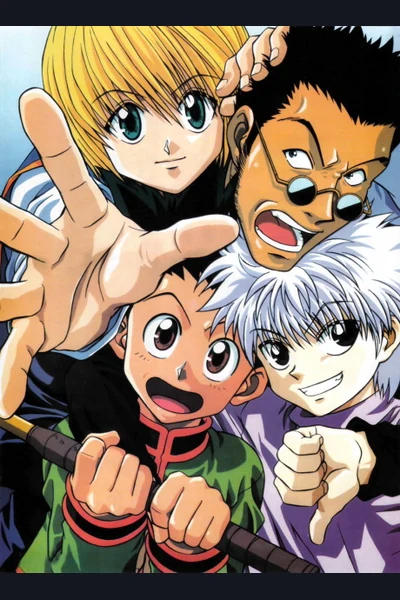
Gon Freecss learns that the father who abandoned him is not merely alive but a celebrated Hunter: a licensed adventurer permitted to enter restricted places, pursue dangerous targets and neglect family obligations at an elite professional level. Gon decides to become a Hunter and find him. Most children would begin with a strongly worded letter.
Yoshihiro Togashi's manga began in Shueisha's Weekly Shonen Jump in 1998 and continues on an irregular schedule shaped by the creator's serious health difficulties. It has received two substantial television adaptations: a 1999 series and Madhouse's more comprehensive 2011 version. The cheerful opening conceals a work willing to dismantle adventure conventions with surgical patience.
Overview
Gon meets Kurapika, Leorio and Killua during the Hunter Exam. Kurapika seeks justice for a massacred clan; Leorio wants the resources to become a doctor; Killua is a child assassin attempting to discover whether friendship can be chosen rather than assigned by his family. Their goals separate and reconnect across arcs that change genre with remarkable confidence.
The story moves through exam ordeal, urban crime, arena combat, virtual-game adventure and the vast Chimera Ant conflict. Each arc establishes rules, then finds the moral and tactical pressure points inside them. Togashi is willing to sideline Gon for long periods if another character or political structure becomes more interesting, which is either narrative courage or evidence that the author has also qualified as a Hunter.
Why it matters
Nen is one of manga's great power systems. Users cultivate aura according to broad categories, individual temperament and self-imposed restrictions. Power grows through risk and specificity. A seemingly modest ability can defeat brute strength if its conditions are understood, turning combat into negotiation, bluff and contract law with explosions.
Togashi uses this machinery to frustrate easy heroism. Gon is kind, determined and alarming. His innocence includes selfishness because he has not learned to distinguish pure desire from moral entitlement. Killua, raised to kill, often possesses the more cautious empathy. Their friendship is genuine and unequal in ways the story slowly makes impossible to ignore.
The Chimera Ant arc is the most famous example of the series' reach, widening from monster threat into war, identity and the formation of humanity. It is long, heavily narrated and capable of transforming a board game into the emotional centre of an apocalypse.
What to expect
The early tone is adventurous, comic and occasionally brutal. Later arcs contain torture, mass death, organised crime and psychological collapse. The 2011 anime's bright palette should not be mistaken for a guarantee that everybody will finish the examination with the same number of limbs.
Fights reward attention to stated conditions. Explanatory narration can be dense, particularly later, but usually reflects the story's interest in decisions rather than decorative complexity. Romance is minimal. Friendship, obsession, family control and moral compromise carry the weight.
Adaptations and versions
The manga is the continuing source and proceeds beyond the 2011 anime into politically dense material. Artwork varies from spare draft-like sequences to extraordinary finished pages, a production reality best approached with sympathy rather than spectator sport.
The 1999 anime has a darker atmosphere and distinctive direction but does not cover as much. The 2011 Madhouse series restarts from the beginning, adapts far more and is the simplest screen route. Several original video animations continue the 1999 continuity, so check labels before accidentally assembling two versions of the same journey.
Where to start
Begin with the 2011 anime for a complete and accessible introduction, or manga volume one for Togashi's original pacing. Do not skip the Hunter Exam as mere setup; its games establish how the series thinks. After the 2011 ending, continue in the manga only if comfortable entering an unfinished and text-heavy expedition.
Verdict The SFcrowsnest take
Hunter x Hunter looks like a boy's adventure and behaves like an author testing how much moral complexity the form can carry before the straps break. Its power system is ingenious, its arcs structurally adventurous and its children often more frightening than the monsters assigned to them.
The irregular publication is frustrating but not a defect to blame upon an ill creator. What exists contains more invention than several completed franchises. Recommended for audiences who enjoy strategic powers, shifting genres and heroes whose brightest qualities cast unexpectedly dark shadows.