
Galaxy Express 999
A boy rides a steam train through the stars to earn himself a free mechanical body; Matsumoto's wistful, gorgeous meditation on mortality dressed as an adventure.
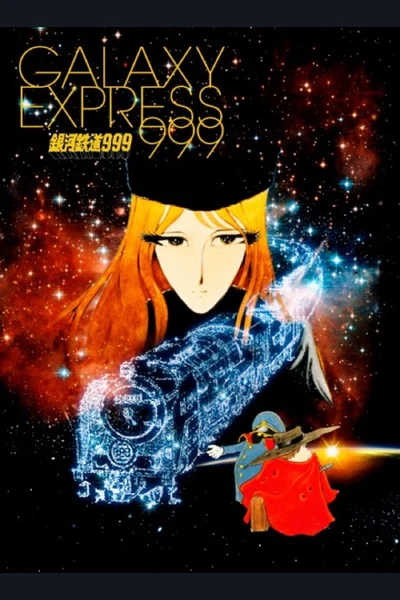
Tetsuro Hoshino wants a mechanical body so he can live forever and avenge his mother's murder. The mysterious Maetel offers him passage aboard the Galaxy Express 999, a steam train travelling between planets. Interstellar transport has retained brass fittings, paper tickets and the emotional reliability of a late-night platform.
Leiji Matsumoto's manga began in 1977, with Toei Animation's television series following in 1978. Feature films condensed and reinterpreted the journey, while later works returned to its railway through the stars.
Overview
Each stop presents another society and another relationship with mortality. Mechanical bodies promise immortality but can create exploitation, boredom or loss of empathy. Human bodies are fragile, finite and therefore precious, a conclusion Tetsuro must reach through repeated encounters rather than accepting from a pamphlet.
Maetel resembles Tetsuro's mother and carries secrets connected to the machine empire. She is guide, protector and one of Matsumoto's archetypal women: impossibly elegant, melancholy and equipped with hair capable of surviving vacuum conditions.
Why it matters
The series turns anthology travel into philosophical education. Planets function as fables about class, technology, grief and desire. Some lessons are blunt, others haunting, and the train always moves on before any civilisation becomes comfortable.
Matsumoto's retro machinery gives the future memory. A steam locomotive in space is absurd and emotionally exact: travel as departure, timetable and inevitable separation.
What to expect
Expect death, poverty, violence and reflective science fiction within a youth adventure. The television series is long and episodic, with vintage production and repeated structures. Romance is secondary; the bond between Maetel and Tetsuro drives the work.
Adaptations and versions
The television anime offers the fullest journey. The 1979 film Galaxy Express 999 provides a visually impressive condensed version with an older Tetsuro and altered events; Adieu Galaxy Express 999 continues that film continuity.
Manga and screen versions diverge. Harlock, Emeraldas and other Matsumoto characters appear, but a complete Leijiverse chart is not required and may actively reduce wellbeing.
Where to start
Choose the 1979 film for a concentrated introduction or the television series for the full station-by-station experience. Read the manga for Matsumoto's line and original rhythm. The destination matters less than how long one is willing to remain aboard.
Verdict The SFcrowsnest take
Galaxy Express 999 is wistful science fiction disguised as a railway adventure. It understands immortality as a sales proposition whose hidden fee is often humanity.
Beautiful, repetitive and deeply sincere, it remains one of Matsumoto's finest journeys. Keep the ticket. The conductor is unlikely to accept an app.