
Captain Harlock (Space Pirate Captain Harlock)
Matsumoto's brooding skull-and-crossbones space pirate, cape billowing against the void; romantic, melancholic space opera at its most operatic.
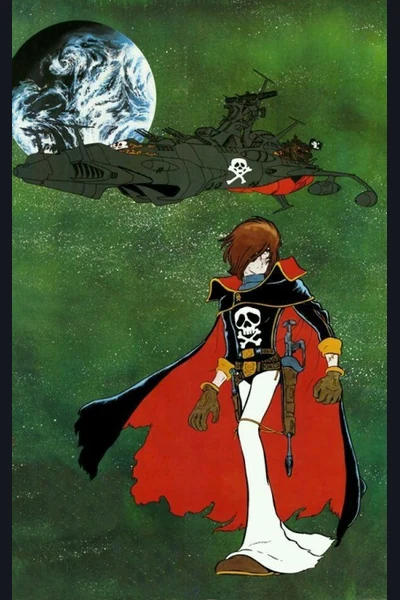
Captain Harlock commands the space pirate ship Arcadia beneath a skull-and-crossbones flag, refusing Earth's complacent government and protecting humanity despite humanity's impressive lack of enthusiasm for deserving it. He has one eye, a scar, a cape and the posture of a man personally disappointed by the century.
Leiji Matsumoto's manga began in 1977; Toei Animation's television series followed in 1978. Harlock also appears across films, alternate series and the loose network often called the Leijiverse, where familiar faces recur without continuity submitting a full explanation.
Overview
In the original story, Earth's population has become passive while the plant-like Mazone approach. Harlock's crew aboard the Arcadia includes engineer Tochiro Oyama's legacy, alien woman Miime and young Tadashi Daiba, who joins after personal tragedy.
Harlock is less a realistic pirate than a romantic ideal of freedom. He rejects institutions, keeps personal promises and conducts resistance with enough billowing fabric to affect cabin pressure.
Why it matters
Matsumoto's space opera combines melancholy, machinery and myth. His ships resemble naval vessels and locomotives because the future carries emotional artefacts from the past. Harlock became an international icon, particularly in France and Italy, embodying rebellion with an unusually elegant silhouette.
The politics are romantic rather than programmatic. Harlock's individualism can inspire or drift into masculine self-mythology. Women in Matsumoto's work are often powerful, mysterious and drawn within a narrow ethereal design, while sturdier men occupy an entirely different species of face.
What to expect
Expect space battles, death, sacrifice and reflective pauses. The original anime targets younger viewers but carries adult fatalism. Pacing is measured and production vintage.
Adaptations and versions
The 1978 series is the main adaptation of the manga. Arcadia of My Youth and Endless Orbit SSX form another origin and continuation. Harlock Saga, Endless Odyssey and the 2013 computer-animated film reinterpret the character again.
These versions contradict one another. Treat them as legends featuring the same captain rather than evidence requiring a tribunal.
Where to start
Begin with the 1978 series for the original television conception or Arcadia of My Youth for concentrated cinematic Harlock. The manga provides Matsumoto's source but remains unfinished in its original form.
Verdict The SFcrowsnest take
Captain Harlock is romantic space piracy at full sail: noble, mournful and gloriously impractical. His appeal lies less in theft than refusal—the refusal to obey a society that has abandoned courage.
Continuity is optional; atmosphere is compulsory. Board the Arcadia, accept the cape and do not expect Earth administration to send a thank-you note.