
Berserk
A lone, brooding swordsman with an implausibly enormous blade against a deeply unfair universe; magnificent, grim, and tragically unfinished. Rest easy, Miura.
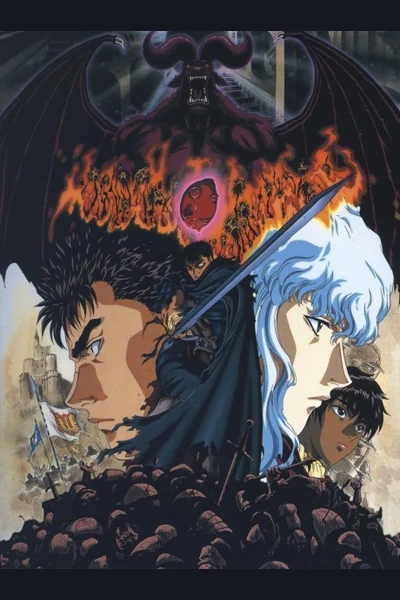
Guts is a mercenary carrying a sword so large that other fantasy heroes could rent rooms inside it. He crosses a medieval world of warfare, cruelty and supernatural horror, pursued by demons and sustained by anger that would have exhausted a lesser endocrine system. This is the visible Berserk: armour, blood and a man refusing to die out of what begins to look like professional discourtesy.
Kentaro Miura's manga began in 1989 and moved to Hakusensha's Young Animal. Miura died in 2021, leaving one of manga's great unfinished works. Publication later continued through his assistants at Studio Gaga under supervision from his close friend Kouji Mori, using the story Miura had shared. That continuation deserves neither automatic rejection nor the pretence that the loss of its creator can be edited away.
Overview
The early Black Swordsman material presents Guts as a brutal wanderer hunting demonic Apostles. The long Golden Age arc then returns to his youth with the Band of the Hawk and its charismatic commander Griffith. Their friendship, ambition and unequal dreams form the tragedy from which the later fantasy grows.
Casca, a senior Hawk commander, is central to both men and repeatedly better than the narrative's treatment of her. The wider story expands through companionship, religion, political collapse and incursions of the astral world. Guts's struggle gradually shifts from revenge towards protecting the people who make survival more than continuation.
Why it matters
Miura's draughtsmanship is monumental. Armies, armour, architecture and monsters accumulate obsessive detail without losing movement. His most horrific pages are famous, but quiet expressions and landscapes carry equal authority. The art makes beauty and terror feel born from the same world.
Berserk also shaped modern dark fantasy across manga, anime and games. Enormous swords, branded wanderers, corrupt religious orders and doomed rivalries echo throughout later work. Influence, however, is not the same as a licence to reduce it to “grim”. Its emotional subject is trauma: whether pain must become violence, and whether accepting care can be a form of strength.
What to expect
This requires the strongest content warning in the guide. Expect graphic violence, torture, sexual assault, child abuse, mutilation, miscarriage imagery and sustained psychological trauma. Sexual violence is sometimes thematically serious and sometimes used with troubling frequency. Readers may admire the work while objecting to those choices.
There is humour and tenderness, especially as a new travelling group forms, but the series earns its reputation for darkness. It is emphatically for adults.
Adaptations and versions
The 1997 television anime adapts the Golden Age with limited animation, superb atmosphere and an abrupt ending. The Golden Age Arc film trilogy retells much of that material with a mixture of traditional and computer animation; the later Memorial Edition revises it for television and adds scenes.
The 2016–17 anime continues later material but its conspicuous computer animation and direction drew widespread criticism. It contains valuable performances but is not an adequate substitute for Miura's pages.
Where to start
Start with manga volume one, accepting that the Golden Age will later reframe its deliberately abrasive opening. Readers who want a screen sample can try the 1997 series, then return to the manga from the beginning. Do not use adaptation order as a replacement for publication order; too much has been omitted between swords.
Verdict The SFcrowsnest take
Berserk is magnificent, excessive, compassionate and frequently unbearable. Guts is memorable not because he can swing the Dragon Slayer but because, after every reason to become nothing but rage, he remains capable of attachment.
Miura's manga is the essential work. No anime has captured its full scale, and no continuation can remove the grief of his absence. Approach with serious content caution and expect something richer than the word grimdark normally permits.