Author Profile · Science Fiction
E. E. 'Doc' Smith
1890–1965 · American
Who was E. E. 'Doc' Smith?
Edward Elmer Smith earned his doctorate in chemical engineering specialising in doughnut mixes, which is the most science-fictional day job in this entire database. By night he invented space opera more or less single-handedly: The Skylark of Space, begun in 1915, was the first story to leave the Solar System at full throttle, and the Lensman saga escalated from there into a two-billion-year war between cosmic civilisations, with fleets of millions and weapons that throw planets. The prose is pure pulp — square-jawed heroes, gosh-wow superlatives — but the conceptual scale was unprecedented and remains genuinely awesome.
Why they matter
The founder of space opera. Every galactic empire, super-fleet and escalating cosmic arms race in the genre — from Star Trek's Federation to Banks's Culture, the Green Lantern Corps to the Death Star — stands somewhere in the Lensman shadow.
Essential books — and where to start
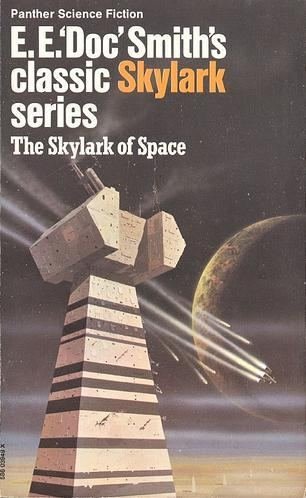
1928 · Skylark, book 1 · Science Fiction · Space Opera
Government chemist Dick Seaton discovers that the mysterious 'metal X' liberates the total energy of copper, builds a starship in his mate's back yard, and blasts off to rescue his kidnapped fiancée from the magnificently villainous Marc 'Blackie' DuQuesne — the first great amoral genius-antagonist of SF. Co-written with Lee Hawkins Garby (who handled the romance), begun in 1915 and finally published in Amazing Stories in 1928, it was the first story to take humanity properly out among the stars, and readers reacted like a dam bursting.
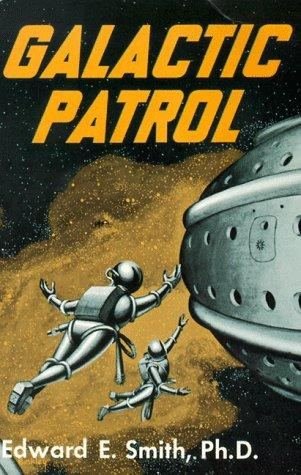
1937 · Lensman, book 3 · Science Fiction · Space Opera, Military SF
Kimball Kinnison graduates top of his class into the Galactic Patrol and receives his Lens — a semi-living Arisian artefact granting telepathy and incorruptibility — then goes hunting the pirate empire of Boskone through space battles of cheerfully ludicrous magnitude. Serialised in Astounding in 1937–38, this is where the Lensman saga proper ignites: the escalation engine (every weapon answered by a bigger one), the secret cosmic war behind the visible one, and the Gray Lensman ethos of incorruptible service. Vintage widescreen pulp, played entirely straight.
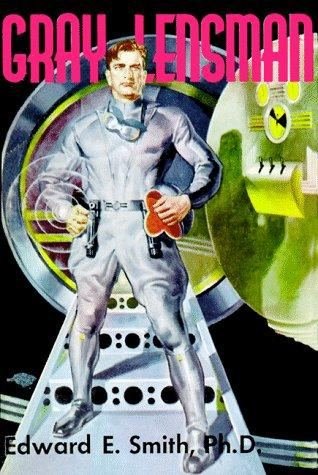
1939 · Lensman, book 4 · Science Fiction · Space Opera, Military SF
Kinnison, now an unattached 'Gray' Lensman answerable to no one, works his way up the Boskonian hierarchy by infiltration, mind-science and the occasional fleet action featuring weapons like the negasphere and the 'sunbeam' — a solar system converted into a vacuum-tube weapon. Smith's escalation reaches a kind of demented grandeur here, while the romance between Kinnison and the red-headed nurse Clarrissa MacDougall (genetic destiny, naturally) gives the saga its human anchor. Serialised in Astounding in 1939 at the height of the magazine's golden age.
Series
1908–2006 · American
A bridge from the Gernsback pulps to the modern field who kept evolving for eight decades.
1920–1992 · American (Russian-born)
One of the Big Three of Golden Age SF.
1954–2013 · British (Scottish)
The writer who revived British space opera virtually single-handed and gave SF its most fully argued utopia.
