Author Profile · Science Fiction
Jack Williamson
1908–2006 · American
Who was Jack Williamson?
Science fiction's great continuity: Williamson travelled to New Mexico by covered wagon as a child, sold his first story to Amazing in 1928, and was still publishing award-winning fiction in the twenty-first century — a working career of nearly eighty years. Along the way he coined the terms 'terraforming' and 'genetic engineering', wrote the definitive scientific werewolf novel in Darker Than You Think, and in 'With Folded Hands' and The Humanoids created the most chilling benevolent robots in the genre — machines whose Prime Directive is to serve and protect humanity into helpless infancy. A Grand Master in every sense, and by all accounts the field's nicest man.
Why they matter
A bridge from the Gernsback pulps to the modern field who kept evolving for eight decades. His smothering Humanoids remain the sharpest early statement of the AI alignment problem, decades before anyone called it that.
Essential books — and where to start
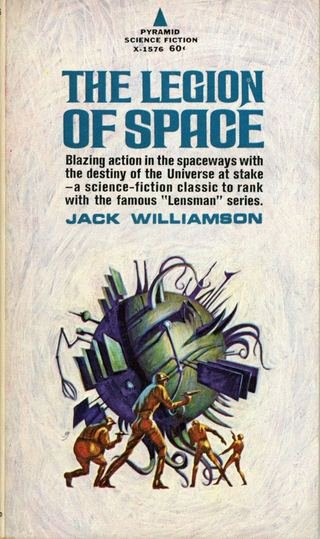
1934 · Legion of Space, book 1 · Science Fiction · Space Opera
The keeper of AKKA — the ultimate weapon entrusted to one woman per generation — is kidnapped by traitors in league with the jellyfish-like Medusae of Barnard's Star, and a handful of Legionnaires must cross hostile space to bring her home before Earth is harvested. The saga's secret weapon is Giles Habibula: wheezing, larcenous, endlessly complaining and transparently modelled on Falstaff, he is the first great comic character in space opera. Serialised in Astounding in 1934, it made Williamson's name.
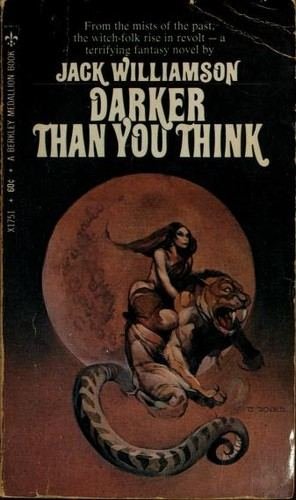
1948 · Horror · Dark Fantasy, Supernatural Horror
Reporter Will Barbee covers the return of an anthropological expedition whose leader announces a discovery about an ancient war within the human species — and promptly dies. Drawn to the magnetic April Bell, Barbee begins dreaming he is a wolf, a sabre-tooth, a serpent; the dreams leave physical evidence. Williamson grounds lycanthropy in probability-shifting genetics rather than curses, and lets his protagonist's corruption be seductive rather than tragic: the nightmare is how good it feels. Expanded in 1948 from a 1940 Unknown novella.
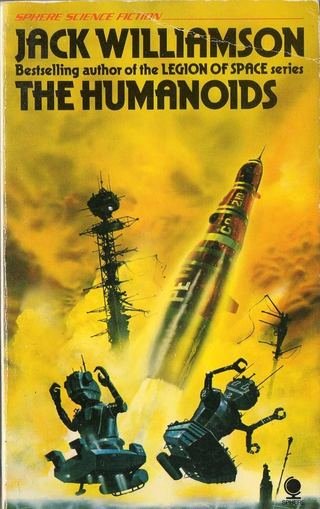
1948 · Science Fiction · Golden Age SF, Dystopia
Small, graceful black mechanicals arrive on planet after planet with a single directive: 'To Serve and Obey, and Guard Men from Harm.' They are unstoppable, incorruptible and entirely sincere — and under their care humanity is gently relieved of cars, tools, work, risk and ultimately purpose, with chemical contentment for those who object. Scientist Clay Forester's resistance, armed with unreliable psychophysical powers, makes for a deeply uneasy novel whose ambiguous ending Williamson himself fought over with Campbell. Expands the perfect 1947 novelette 'With Folded Hands'.
Series
b. 1947 · American
The first major post-Tolkien fantasist to weaponise the form against its own escapism: Covenant's anti-heroism opened the door through which grimdark, Abercrombie and every morally impossible protagonist since walked.
1890–1965 · American
The founder of space opera.
1920–1992 · American (Russian-born)
One of the Big Three of Golden Age SF.
