
Vagabond
Inoue's breathtaking brush-and-ink retelling of swordsman Miyamoto Musashi; less a comic than a touring gallery of fine art, and frequently named the medium's most beautiful.
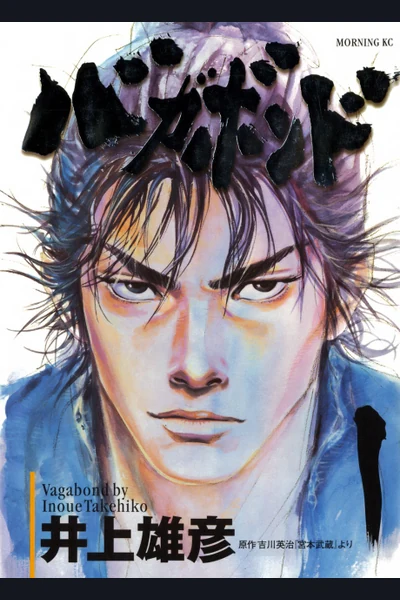
Takezo Shinmen survives the Battle of Sekigahara and returns home ferocious, humiliated and convinced strength means defeating everybody placed in front of him. A monk renames him Miyamoto Musashi and redirects that fury towards discipline, though redirect is doing generous work for a process involving many swords and several existential collapses.
Takehiko Inoue began Vagabond in Kodansha's Morning in 1998, drawing upon Eiji Yoshikawa's novel Musashi and the legendary swordsman's life. Publication has been on indefinite hiatus since 2015. Thirty-seven collected volumes exist; no anime adaptation does, perhaps because nobody has volunteered to make Inoue's brushwork move without committing an act of vandalism.
Overview
Musashi travels through early Edo-period Japan seeking opponents and the meaning of invincibility. His childhood companion Matahachi follows a weaker, painfully human route. Sasaki Kojiro is reimagined as a deaf swordsman whose physical understanding of the world becomes its own language.
The battles are extraordinary, but long stretches concern farming, hunger, landscape and the slow dismantling of Musashi's certainty. A sword can prove who survived an exchange. It cannot prove how to live.
Why it matters
Inoue's artwork is among manga's finest: wet brush, spare line, dense crowds and faces carrying thought before dialogue arrives. He can turn a duel into fractured perception or let grass occupy the page until violence feels like an intrusion.
The work interrogates the heroic swordsman it appears to celebrate. Musashi's pursuit of strength begins as fear wearing aggression. Maturity requires recognising connection and dependence, revelations far less marketable than cutting down another school.
What to expect
Expect graphic sword violence, death, sexual material, poverty and long philosophical passages. Historical figures are freely dramatised through Yoshikawa and Inoue; this is literary fiction, not a biography with unusually fine ink.
The unfinished status matters. Readers receive a substantial journey without a final published conclusion.
Adaptations and versions
There is no anime. Deluxe and omnibus editions offer larger reproduction well suited to the art, though availability and print quality vary. Inoue's exhibition work included a possible concluding reflection, but it is not a substitute final manga volume.
Where to start
Begin with volume one and read slowly. Digital editions provide access; large-format print better serves the brushwork if cost and shelf strength permit.
Verdict The SFcrowsnest take
Vagabond is not a gallery pretending to be a comic. It is comics art operating at gallery level while retaining mud, motion and serial uncertainty.
Unfinished, violent and magnificent. Musashi seeks invincibility; Inoue finds something more difficult in the spaces where he lowers the sword.