
The Vision of Escaflowne
A schoolgirl is whisked to a world of duelling kingdoms, tarot-driven fate and steam-powered mecha; a fondly remembered 90s blend of fantasy, romance and giant robots.
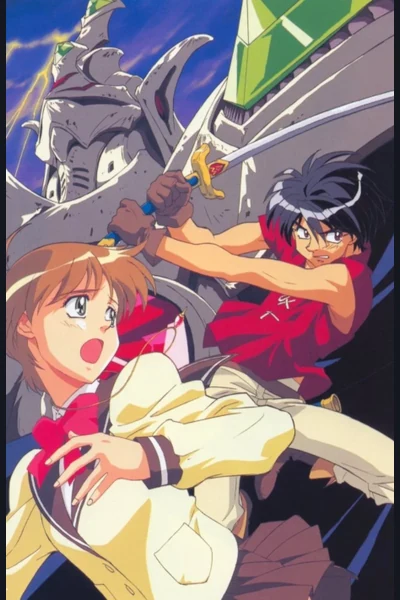
Hitomi Kanzaki is a schoolgirl, runner and amateur tarot reader whose visions bring a young swordsman named Van crashing into her athletics track, closely followed by a dragon. She is transported to Gaea, where Earth hangs in the sky and international disputes are conducted with steel, sorcery and armoured giants. Careers advice had not covered this.
Overview
Sunrise's 1996 television series blends portal fantasy, romance, war drama and transforming mecha. Van is heir to the ruined kingdom of Fanelia and pilot of Escaflowne, a Guymelef powered by a dragon's energist. Hitomi's developing visions make her valuable to allies and to the Zaibach Empire, which seeks to manipulate fate itself.
The resulting journey includes knightly Allen Schezar, cat-woman Merle, royal politics and a romantic triangle with enough sharp edges to require armour. Hitomi remains emotionally central even when the machinery grows louder around her.
Why it matters
Long before “isekai” became a dominant marketing category, Escaflowne demonstrated how freely the form could mix audiences and traditions. Its mecha are not imported military hardware but articulated fantasy armour; its heroine's feelings affect a plot concerned with destiny without reducing her to a reward for the pilot.
Shoji Kawamori's mechanical imagination, Kazuki Akane's direction and Yoko Kanno and Hajime Mizoguchi's music give the series an identity no spreadsheet of component genres can reproduce. The choral score arrives as though every sword fight has accidentally opened a cathedral.
What to expect
Expect aerial kingdoms, divination, romance, political war and elegant machines fighting at intimate range. The story moves quickly—sometimes because its planned length was reduced—and later explanations can arrive with the breathlessness of a courier who has misplaced several episodes.
Violence, death and trauma accompany the adventure. Some character designs, particularly their magnificent noses, can surprise viewers trained by smoother modern fashion. They convey personality beautifully once the face has had time to introduce itself.
Adaptations and versions
The television anime is the principal work. Manga adaptations developed around it but tell significantly different stories and should not be treated as its source.
The film Escaflowne is a darker, visually lavish alternative retelling with changed characters and mythology. A heavily edited television version once attempted to reshape the series for younger Western viewers; seek an uncut release, since fate is complicated enough without a broadcaster removing the connective tissue.
Where to start
Start with the original 26-episode television series. It contains the full alchemy of romance, mecha and Kanno's score. Watch the film afterwards as a handsome parallel dream rather than a continuation.
Verdict The SFcrowsnest take
The Vision of Escaflowne is a singular machine: part fairy tale, part war epic, part adolescent ache, all driven by music capable of levitating the furniture. Its compressed plot wobbles, but its conviction never does. Gaea remains one of anime's finest arguments for ignoring the walls between genre shelves.