
The Promised Neverland
Gifted orphans discover their idyllic home is a farm, and they are the livestock; a taut escape thriller best experienced one un-spoiled season at a time.
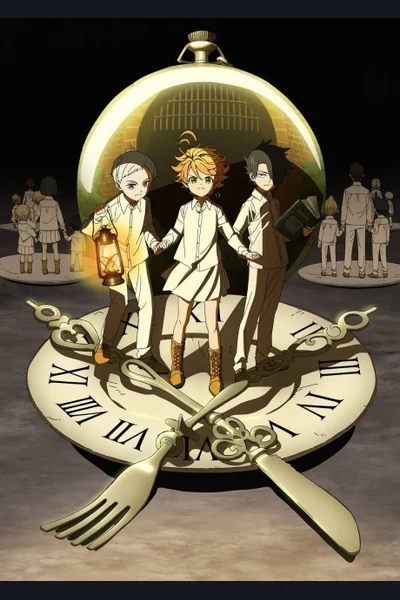
Grace Field House is an idyllic orphanage. Its children are loved, well fed and tested daily, while those selected for adoption depart through a gate and never write. Emma, Norman and Ray discover that the home is a farm and the children are livestock. Their excellent education has, inconveniently for management, produced very capable prisoners.
Overview
Written by Kaiu Shirai and drawn by Posuka Demizu, The Promised Neverland begins as an escape thriller conducted by children who must smile at their jailer. Emma supplies moral determination, Norman strategic calm and Ray a colder practicality. Isabella—the woman they call Mum—controls the house with maternal warmth sharpened into surveillance.
The first arc thrives on restricted space and information. Every conversation may be overheard, every child adds another rescue problem, and open resistance would bring immediate disaster. A game of tag can function as training, reconnaissance and threat assessment without ceasing to look like children playing.
Why it matters
The series made intellectual conflict feel as urgent as physical combat. Its young protagonists cannot defeat the adult system by strength, so attention and trust become survival skills. Demizu's elastic artwork shifts from storybook comfort to predatory distortion, revealing the horror already concealed inside the nursery furniture.
Beyond the opening, the manga expands into dark fantasy and asks whether escape is enough when the machinery that consumed you remains in place. Not every later answer has the first arc's elegant pressure, but the ambition is genuine.
What to expect
The premise itself is an early revelation and unavoidable in a useful guide; many further turns are best left untouched. Expect child endangerment, death, psychological manipulation, monsters, weapons and disturbing imagery. Graphic detail is selective, which allows anticipation to do much of the unpleasant work.
This is not nihilism wearing a school uniform. Emma's refusal to reduce vulnerable people to acceptable losses gives the story its moral argument, even when that idealism makes every plan appallingly difficult.
Adaptations and versions
The completed manga tells the entire story. CloverWorks' first anime season adapts the Grace Field escape with exceptional control, using framing, silence and music to intensify the mind games. It is one of those rare adaptations that makes a ceiling corner feel accusatory.
The second anime season compresses and removes substantial manga arcs on its rush toward an ending. Viewers wanting the full narrative should return to the manga after season one—preferably from the beginning, or at minimum before assuming the screen version has merely shortened the scenery.
Where to start
Start with anime season one for a superb, nearly self-contained thriller. Then read the manga for the complete route. Starting directly with volume one is equally sound and preserves Demizu's visual clues in their original form.
Verdict The SFcrowsnest take
At its peak, The Promised Neverland turns childhood obedience into the surface of a prison break and makes a whispered conversation more dangerous than artillery. The anime's later shortcut is infamous for good reason, but it does not erase a remarkable first season or the manga's larger journey. Grace Field welcomes visitors. Do inspect the menu before accepting dinner.