
Death Note
A bored genius finds a notebook that kills anyone whose name he writes; a battle of wits so tense it makes eating a crisp feel like a plot twist.
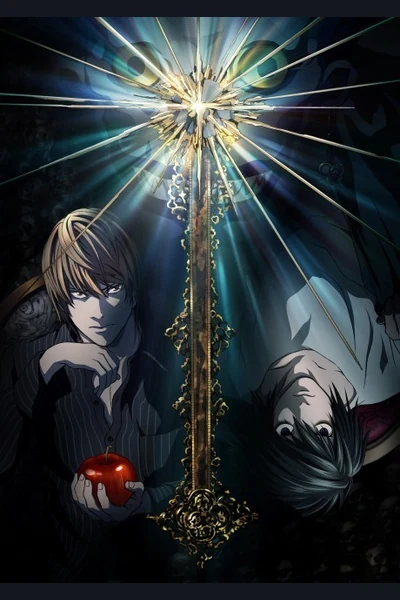
Light Yagami is a brilliant student bored with the world. He finds a notebook dropped by the death god Ryuk: write a person's name while picturing their face and that person dies. Light tests it, confirms the rules and decides to cleanse society of criminals. Absolute power has taken less than an afternoon to complete its induction.
Tsugumi Ohba wrote the manga with art by Takeshi Obata; it ran in Shueisha's Weekly Shonen Jump from 2003 to 2006 and filled 12 volumes. Madhouse's 37-episode anime followed in 2006–07. Japanese live-action films, television drama, stage musical and an American film demonstrate the premise's portability, though not every customs inspection has gone smoothly.
Overview
As criminals die, the public names the unseen killer Kira. The world's greatest detective, L, takes the case. Light needs L's true name and face; L needs proof that murder can be committed through impossible means. Their contest becomes an elaborate exchange of surveillance, deception and rules lawyering.
Ryuk watches for entertainment, eating apples and refusing to supply the moral guidance Light never requested. Other notebooks and users complicate the duel, but the central attraction remains two prodigies attempting to make the other reveal one fatal piece of information.
Why it matters
Death Note converts supernatural power into procedure. The notebook has specific rules, and Ohba builds suspense from how Light exploits or appears constrained by them. Plans nest inside plans until a packet of crisps can be filmed with the intensity of a state funeral.
Light is compelling because the story does not require him to be secretly right. His language of justice quickly conceals vanity, fear and appetite for control. The public's support for Kira raises the darker issue: authoritarian violence can become popular when marketed as safety and aimed first at people society has already agreed not to mourn.
L is no simple moral opposite. He is manipulative, invasive and willing to endanger others. The difference is not spotless virtue but accountability: Light answers only to himself and therefore discovers that every obstacle is another person who deserves removal.
What to expect
Expect death, psychological manipulation, confinement, suicide themes and misogyny within both characters and aspects of the storytelling. Physical gore is limited; tension comes from anticipation and moral deterioration. Comedy arrives chiefly through Ryuk and the absurd seriousness of genius behaviour.
Romance is instrumental rather than tender. Several women are treated badly by Light and not always granted equal complexity by the narrative. This is worth acknowledging rather than explaining away as proof of his villainy whenever the framing also enjoys the convenience.
Adaptations and versions
The manga is concise and gives Obata's controlled art room to carry small expressions. Madhouse's anime is highly faithful, with dramatic direction, music and performances that enlarge the duel. It moves faster through later material, so manga readers receive more detail after the story's major structural turn.
The Japanese live-action films make intelligent changes and build an alternate conclusion. The Netflix film relocates the story to America and alters Light substantially; it works as a loose reinterpretation but not as an efficient substitute. The musical is another adaptation and, improbably, one of the more interesting ones.
Where to start
Start with manga volume one or anime episode one. Both establish the rules immediately. The anime is an ideal thriller binge until one realises that sleep deprivation is giving Light an unearned tactical advantage.
Verdict The SFcrowsnest take
Death Note is a beautifully engineered argument about a clever young man mistaking the ability to punish for the right to judge. Its plotting occasionally strains under its own nested brilliance, and its treatment of women is weaker than its treatment of rules.
The Light–L contest remains irresistible. Read the manga for precision or watch the anime for operatic tension. Either way, keep your name off unsecured stationery and never trust a bored god carrying fruit.