Dandadan
Two teenagers argue over whether ghosts or aliens are real, then get harassed by both at once; animated like a fever dream you'd happily book again.
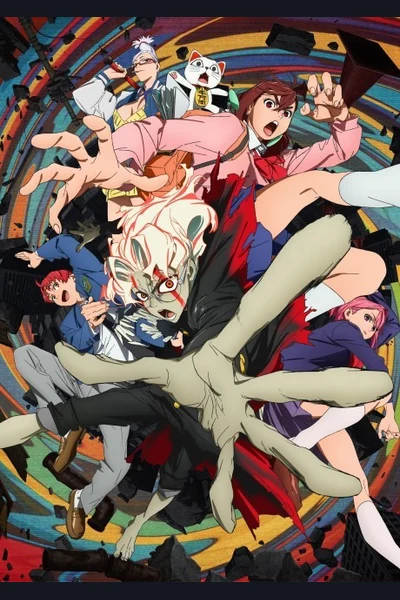
Momo Ayase believes in ghosts but regards aliens as nonsense. Ken Takakura, an awkward occult obsessive immediately nicknamed Okarun because he shares a name with Momo's favourite actor, believes in aliens but not ghosts. Each challenges the other to visit a location associated with the disputed phenomenon. Both are right, which would be intellectually satisfying if the proof did not immediately attempt abduction, possession and the theft of Okarun's reproductive equipment.
Dandadan is not a series that believes in easing people into the swimming pool.
Yukinobu Tatsu's manga began on Shueisha's Shonen Jump+ service in 2021. Science SARU's anime adaptation followed in 2024. The result combines UFO conspiracy, Japanese ghost lore, romantic comedy, battle manga and the emotional volatility of adolescence, then shakes the container until the lid achieves escape velocity.
Overview
Momo comes from a family of spirit mediums and has psychic ability. Okarun becomes entangled with Turbo Granny, a grotesque and foul-mouthed spirit whose curse grants speed and power at a cost. Together they confront aliens, yokai, cursed objects and other teenagers whose problems have acquired supernatural amplification.
The premise sounds like random escalation, but the series has a dependable centre: Momo and Okarun like one another before either possesses the nerve or timing to make this administratively simple. Their relationship grows through rescues, misunderstandings, jealousy and the rare conversations not interrupted by a giant anatomical metaphor. Tatsu understands that romantic tension and paranormal combat run on similar fuel: anticipation, embarrassment and somebody refusing to say what is plainly happening.
The supporting cast expands quickly, often by turning a temporary nuisance into a damaged ally. Backstories arrive with surprising emotional force. A monster introduced as an absurd visual gag may reveal grief, exploitation or parental loss. The series can be ridiculous without treating pain as ridiculous, a balance many supposedly more dignified works misplace in a labelled drawer.
Why it matters
Tatsu worked as an assistant to Tatsuki Fujimoto and Yuji Kaku, and Dandadan shares some of their appetite for abrupt tonal change and spectacular composition. His art is astonishingly detailed when architecture, machinery or mass destruction arrives, yet loose and elastic in comedy. Weekly digital publication has not persuaded him that a page needs fewer impossible objects.
The collision of aliens and yokai is more than novelty. Science-fiction invaders approach humanity as specimens; ghosts carry memories, grudges and local histories. One threatens from outside, the other rises from what people have failed to mourn. Momo and Okarun are caught between modern paranoia and older folklore, while still needing to attend school and decide whether holding hands constitutes a strategic development.
Science SARU translates this into animation through bold colour changes, graphic design and movement that embraces the manga's lunacy rather than attempting to make it behave. Different paranormal zones receive distinctive palettes and rhythms. The production looks as though somebody gave an art department permission to hallucinate responsibly.
What to expect
Expect frantic action, grotesque monsters, sexual jokes, profanity, adolescent embarrassment and periodic emotional ambush. The opening material includes attempted sexual assault and coercive imagery played within a deliberately outrageous alien encounter. Later comedy continues to circle bodies and missing anatomy. Viewers sensitive to that material should not mistake the bright colour for a content exemption.
Violence is energetic and often strange rather than relentlessly gory. Horror imagery can be genuinely eerie before the characters begin shouting at it. The romance is unusually important for a battle series and gives the chaos direction. Comedy ranges from sharp character work to a joke being fired through the wall at high speed.
Adaptations and versions
The manga is the source, fast to read and the best place to admire Tatsu's page design. It also moves beyond the animated material, making it the obvious choice for impatient converts. The anime follows closely while reorganising certain beats for episodes and using sound, music and colour as additional weapons.
Current seasons, compilation screenings and UK platforms should be checked at publication. The main route remains pleasantly uncomplicated: manga in chapter order or anime in broadcast order. No prequel seminar is required, although a working tolerance for haunted infrastructure will help.
Where to start
Begin with the first anime episode if you want to know whether the tonal mixture works for you. It contains enough aliens, ghosts, romance and inappropriate peril to serve as an honest declaration of intent. Manga volume one is equally direct and slightly less likely to make the furniture vibrate.
Verdict The SFcrowsnest take
Dandadan behaves like five genres escaping from adjacent rooms and discovering they can form a band. It should be exhausting. Instead, Momo and Okarun's shy, credible attachment gives the noise a pulse, while Tatsu's compassion turns disposable monsters into people one remembers.
It is inventive, beautifully made and frequently indecorous. Recommended for viewers and readers who can tolerate sexualised absurdity, sudden sadness and an occult grandmother with no respect for personal boundaries. Ghosts and aliens are both real. Sensible pacing has yet to be confirmed.