Solo Leveling
The weakest hunter alive is gifted a video-game levelling system and methodically becomes a one-man apocalypse; unbothered comfort-food power fantasy.
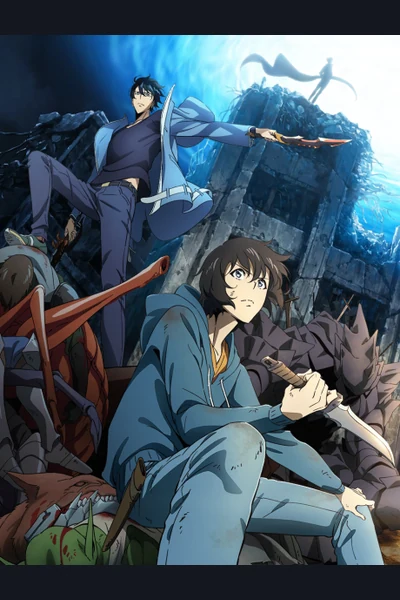
Sung Jinwoo is officially the weakest hunter in the world, a title unlikely to improve morale during appraisal season. Hunters enter magical gates, clear monster-filled dungeons and collect the rewards. Jinwoo enters because his mother's treatment costs money and his family needs him, despite possessing roughly the combat durability of an apologetic breadstick.
After a dungeon expedition becomes a lethal trap, Jinwoo alone is offered access to the System: a game-like interface that assigns quests, measures attributes and allows him to level up. Other hunters are stuck with the abilities they awakened. Jinwoo has been given progression, daily exercise and penalties for non-compliance. The universe has reinvented the personal trainer and made it homicidal.
Solo Leveling began as a Korean web novel by Chugong in 2016. Its webtoon adaptation, illustrated principally by the late Jang Sung-rak, known as Dubu, supplied the images through which most international readers first encountered it. A-1 Pictures' anime adaptation began in 2024. This is Korean source material adapted by a Japanese studio, a distinction worth retaining rather than filing the entire continent under anime and hoping nobody notices.
Overview
The story's pleasures are announced in the title. Jinwoo grows stronger, acquires abilities and moves from liability to a figure capable of making high-ranked hunters reconsider the organisational chart. Dungeons provide discrete challenges, monsters provide measurable opposition and the System turns improvement into visible numbers. It is the fantasy of competence with the progress bar left on screen.
Jinwoo's motivation begins in vulnerability and duty rather than conquest. He needs money, wants to protect his sister and has spent years accepting humiliation because refusing dangerous work is a luxury. That foundation makes his early improvement satisfying. Each victory answers a period when he could not protect himself or anyone else.
As power accumulates, the emphasis changes. Jinwoo becomes cooler, quieter and increasingly remote, while the scale expands from dungeon survival to international and supernatural conflict. Readers who enjoy ruthless capability will regard this as delivery of the advertised goods. Those looking for a hero continually troubled by moral uncertainty may find that uncertainty has been asked to wait outside while Jinwoo finishes the boss.
Why it matters
The webtoon became one of the defining international Korean digital comics of its period. Its vertical format, dramatic scrolling reveals and saturated artwork made it particularly effective on phones. Dubu's rendition of Jinwoo—dark clothing, glowing eyes and an army emerging from shadow—gave the property a visual identity capable of travelling ahead of the novel.
Its influence can be seen in the visibility of Korean web novels and manhwa within global genre publishing. Solo Leveling did not invent gates, systems or overpowered protagonists, but it presented them with exceptional polish and legibility. It is comfort reading for anybody who has wanted hard work to produce an unambiguous numerical result rather than a meeting about future opportunities.
The simplicity is both strength and limitation. Secondary characters often exist to measure Jinwoo's new altitude. Political and institutional material widens the world, but the central attraction remains transformation. The series is not embarrassed by power fantasy; it has put on a dark coat and booked the largest room available.
What to expect
Expect frequent combat, dungeon horror, monsters, blood and large casualties. Early episodes emphasise helplessness and can be tense. Later material emphasises dominance and spectacle. Comedy is occasional, romance secondary and introspection concentrated around family, responsibility and the remains of Jinwoo's former self.
Game terminology is used clearly enough for viewers who do not spend evenings comparing damage multipliers. The anime adds weight through music, voice performance and action choreography, while changing some presentation details between Korean and Japanese contexts. Check which language and localisation a release uses if names are important to you; the international edition generally retains the Korean identities.
Adaptations and versions
The original web novel supplies the complete prose version. The manhwa is the most immediately readable adaptation and the source of the franchise's famous visual language. The anime follows the same main route while expanding fights and distributing revelations across episodes.
Begin with whichever form suits your appetite: prose for detail, manhwa for rapid visual momentum, anime for movement and sound. Reading all three is comparison, not obligation. The story contains enough levelling without assigning it to the audience.
Where to start
The anime's opening episodes provide an effective introduction, but allow it to reach the double-dungeon crisis before deciding whether the premise has teeth. The manhwa is the fastest path through the story and arguably the property's natural showcase. Read from the beginning; scrolling past the early weakness removes much of the satisfaction from what follows.
Verdict The SFcrowsnest take
Solo Leveling is a superbly packaged fantasy of becoming so competent that the world must revise its opinion in public. It is not particularly interested in questioning whether limitless advancement is healthy. It is interested in making the advancement look magnificent, and on those terms it delivers with alarming efficiency.
Recommended for action readers who enjoy game systems, dramatic reversals and heroes who eventually enter a room as its new weather. The emotional range narrows as the power broadens, but the momentum rarely apologises. Sometimes comfort food arrives with an undead army. One should still check the portion size.